E-mail:
sales@silicone-sealant-china.com

Short answer: no — not reliably. New silicone will not form a proper bond with cured silicone residue left behind in a joint. It may look fine for a few weeks, but the new bead will sit on top of the old material rather than fusing to the substrate, and sooner or later it peels away. This is the single biggest reason resealed bathrooms and windows fail. Here is why it happens and how to do the job so it lasts.
Cured silicone is chemically inert. Once the cross-linking reaction is complete, the surface has no reactive sites left for a fresh bead to bond with. A new layer of the same chemistry has nothing to grab onto, so adhesion is purely mechanical at best — and that hold is weak.
There is a second problem too. Old silicone residue is rarely clean. It traps soap scum, dust, oils, and often mould spores. Even if the new bead did achieve some grip, it is bonding to contamination rather than to the tile, glass, or metal underneath.
Jobs that were applied over old residue show a predictable pattern of failure:
If you can slide a fingernail under the edge of a bead and lift it cleanly, it was bonded to old material, not to the substrate.
Getting every trace out is the whole job. Work through these steps:
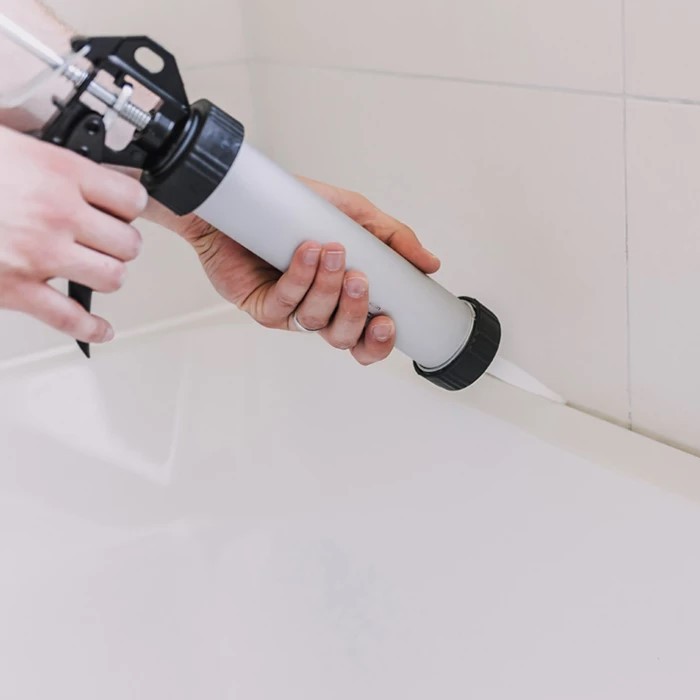
There is a narrow exception. Some hybrid and acrylic-based products are formulated to bond to cured silicone when a specific primer is used, which is useful in awkward joints that cannot be fully stripped. Our acrylic sealant range covers several of these overcoat-friendly options. Read the technical data sheet carefully — most standard silicones simply do not offer this, regardless of what a label implies.
Once the joint is genuinely clean, pick a sealant that suits the substrate and the environment:
Allow the new bead to cure fully before exposing it to water — 24 hours minimum for most products, longer in cold or damp conditions.
New silicone will not stick to old silicone residue in any dependable way. Silicone cannot bond to cured silicone, and residue carries contamination that undermines whatever grip remains. Removing every trace of the old bead — mechanically, chemically, then with solvent — is not optional tidying up; it is the job itself. Do that properly, choose a sealant matched to the substrate, and the reseal will hold for years rather than weeks.
Copyright 2019 by Hangzhou Silicone Tech Adhesive Co., Ltd. All rights reserved.
Bathroom Sealant | Acrylic Sealant | Dow Corning 795 | Aquarium Sealant | Dow Corning 732 | Clear Silicone Sealant | Polysulfide Sealant | Glazing Sealant | Mirror Sealant | IG Sealant
Powered by Onepound


