E-mail:
sales@silicone-sealant-china.com

There's a tendency when sealing bathrooms to think more is better. Squeeze a thick bead, smooth it once, and hope for the best. That approach works in dry rooms where the sealant sits quietly behind a cabinet. In a bathroom, where steam hits every surface daily and water pressure pushes against every joint, a thick single coat is basically a ticking time bomb.
The professional approach is counterintuitive—apply sealant in thin layers, multiple passes, with curing time between each coat. It sounds slow. It is slow. But it produces a bond that survives years of thermal cycling and water exposure where a thick single bead would crack and peel within a season.
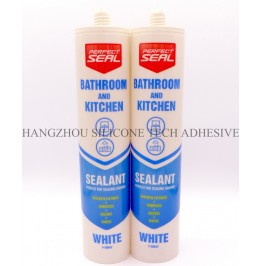
Here's what happens when you apply a thick bead of sealant in one go. The outer surface reacts with moisture in the air first—it skins over. Meanwhile, the material deep inside the bead is still wet, still curing, still shrinking as it cross-links.
That differential cure creates internal stress. The skin pulls away from the uncured core like a crust forming over bread dough that's still rising underneath. Eventually the skin cracks, and those cracks run straight down to the substrate. Water finds them instantly.
Thin layers solve this because each coat is thin enough to cure through completely before the next one goes on. No skin-over. No trapped moisture. No internal stress. The whole thickness cures uniformly from top to bottom.
Sealant adhesion isn't just about surface contact—it's about how deep the bond penetrates into the substrate's micro-texture. A thick bead sitting on top of a surface only bonds at the very top layer. The bottom half of the bead is essentially floating, held in place by friction rather than chemical adhesion.
When you apply thin coats, each layer wets the surface completely and bonds at a molecular level. The second coat bonds to the first coat's surface, which is already fully cured and chemically stable. You end up with a laminated structure where every layer is bonded to the one below it—like plywood versus a solid block of wood with internal voids.
That laminated bond is far more resistant to peeling forces. Water pressure pushes against the outer layer, but the load transfers through each bonded interface instead of concentrating at one weak point.
Start with a very thin bead—barely visible, maybe 1mm thick. This isn't meant to fill the joint. It's meant to wet the surface. Run it along the entire joint length, pressing it firmly into both substrate surfaces with your tool.
Think of this coat as a primer. It seeps into every pore, every micro-crack, every irregularity in the substrate. It creates a fully bonded base layer that the subsequent coats will stick to.
Let this first coat cure completely. Depending on temperature and humidity, that means anywhere from 2 to 8 hours for most bathroom sealants. Don't guess—check the technical data sheet for skin-over time and full cure time. The first coat must be fully cured before you touch it with the second coat.
Apply the second coat the same way—thin, even, pressed into the joint. This time you're building depth. Each pass adds maybe 1 to 2mm of thickness. For a typical bathroom joint that needs 6mm total depth, you'd run three or four thin coats instead of one thick one.
The key difference between coats is timing. Between each application, wait until the previous coat has skinned over but not fully cured—that tacky window where the surface is stable enough to receive new material but still chemically active enough to bond. Most sealants hit that window around 15 to 30 minutes after application in normal bathroom conditions.
If you wait too long and the coat fully cures, you need to lightly score the surface with a knife or abrasive pad before applying the next coat. That scoring gives the new layer something to grip mechanically. Without scoring, the second coat slides over the first like ice on ice.
The last coat is where you get the finish right. This one determines the final bead profile—the concave shape that sheds water, the smooth surface that resists mold, the clean edges that don't collect grime.
Tool this final coat carefully. Use a wetted tool or a rounded spatula pressed at 45 degrees to the joint. Move steadily, compressing the sealant into the joint and creating that slight inward curve. The goal is maximum contact at the bottom of the joint where water pressure is highest, tapering to a thin edge at the top where appearance matters most.
Don't add extra thickness here just to make it look beefy. The total depth should match what the joint actually needs—usually 6mm to 10mm for standard bathroom applications. Anything thicker than 12mm invites trouble.
Joints near toilets, bathtubs, and sinks move constantly. Every time someone sits down, the toilet rocks slightly. Every time the tub fills, the fixture flexes. Those movements put shear stress on the sealant that a single thick bead can't absorb.
Thin multi-coat application creates a more flexible bond because each layer can move independently to a small degree. The laminated structure distributes shear across multiple interfaces instead of concentrating it at one substrate bond line. It's the difference between a rigid weld and a flexible hinge.
For these high-movement joints, consider using a backer rod to control depth, then build up with four or five thin coats instead of trying to fill the gap in one or two thick applications.
Gravity works against you on walls and ceilings. A thick bead on a vertical surface sags before it cures, thinning at the top and pooling at the bottom. That uneven thickness means uneven cure—the thin top dries too fast, the thick bottom stays wet for days.
Thin coats on vertical surfaces stay where you put them. Each layer is light enough that gravity doesn't pull it down before it skins. Apply from bottom to top, waiting between coats, and you get uniform thickness from floor to ceiling without a single drip.
Overhead joints—like where a showerhead pipe meets the ceiling—are the worst case. Multi-coat is practically mandatory here. Start with a bead pressed up against the pipe, let it set, add another thin layer, let it set, and repeat until you reach the needed depth. Rushing this with one thick bead means watching it sag onto your face while you work.
Patience is the enemy of impatience, and impatience is the enemy of good sealant work. I've watched installers apply coat after coat with five minutes between each, wondering why the whole thing peels off a month later. Five minutes isn't enough for most sealants to skin over properly.
The rule: wait at least the minimum recoat time specified on the technical data sheet. For many bathroom-grade sealants, that's 20 to 30 minutes at 23°C and 50% humidity. In cooler or more humid conditions, it stretches to 45 minutes or more. When in doubt, wait longer. A slow job that lasts beats a fast job that fails.
The first coat needs firm pressure to wet the substrate. Later coats need gentler pressure—just enough to bond, not so much that you squeeze material out of the joint or compress earlier coats into an uneven shape.
If you press hard on the third coat, you might push the first coat away from the substrate on one side, creating a void. Think of each coat as a delicate layer. Treat it that way.
If you start applying coats at 20°C and the bathroom heats up to 28°C because someone turns on the water heater, your cure times change mid-job. The first coat cures faster than expected, the second coat skins before you can tool it, and suddenly your carefully planned multi-coat schedule is out of whack.
Monitor the temperature. If it's climbing, speed up your workflow or switch to a faster-curing formulation for the remaining coats. If it's dropping, slow down and give each coat extra time. The multi-coat method only works when you control the variables between each application.
Here's a detail most guides skip. Between coats, you don't need to do a full surface prep—no solvent wipe, no abrasive pad, no primer reapplication. But you do need to make sure the previous coat's surface is ready to receive new material.
If the previous coat has fully cured and feels smooth, run a utility knife lightly across it in a crosshatch pattern. Shallow scores—maybe 0.5mm deep—give the new coat mechanical keying without damaging the underlying bond. Wipe away the dust with a dry cloth. That's it.
If the previous coat is still in the tacky window (not fully cured), skip the scoring entirely. Just apply the next coat directly. The chemical bond between a tacky surface and fresh sealant is actually stronger than any mechanical key.
Every minute you spend waiting between coats is a minute for dust to settle. Bathrooms generate a lot of dust—from grinding, sanding, even just walking around on dry days. That dust lands on your tacky sealant surface and becomes a contamination layer.
Cover the area with painter's tape or plastic sheeting between coats if you're working on multiple joints. If you're doing one long joint, at least close the bathroom door and turn off any fans that blow dust around. A single speck of dust at the interface between coats creates a weak point that propagates through the entire laminate.
The multi-coat method demands a cleaner environment than single-coat application. That's the trade-off—more steps, more waiting, more attention to detail. But the payoff is a sealant joint that moves with the building instead of fighting it, that cures evenly instead of cracking internally, and that stays bonded for years instead of peeling in months.
Copyright 2019 by Hangzhou Silicone Tech Adhesive Co., Ltd. All rights reserved.
Bathroom Sealant | Acrylic Sealant | Dow Corning 795 | Aquarium Sealant | Dow Corning 732 | Clear Silicone Sealant | Polysulfide Sealant | Glazing Sealant | Mirror Sealant | IG Sealant
Powered by Onepound


