E-mail:
sales@silicone-sealant-china.com

Everyone focuses on which sealant to buy. Hardly anyone talks about what happens where two beads meet. That intersection—where the tub-to-wall line crosses the corner bead, or where the sink caulk runs into the backsplash joint—is the single most vulnerable point in any bathroom waterproofing system. Water doesn't attack the middle of a long bead. It finds the seam between two beads and works its way behind everything from there.
This isn't theoretical. Walk into any bathroom that's been resealed by a DIYer and you'll find it—a T-joint or cross-joint where two separate applications meet, often with a visible gap, a ridge, or a thin line of mold right at the intersection. That spot failed not because the sealant was bad, but because nobody thought about how the two beads would connect.
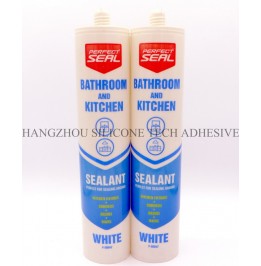
Picture water running down a shower wall. It hits the horizontal bead where the wall meets the tub, then it encounters the vertical corner bead. At that intersection, water doesn't just flow past—it pools. The geometry creates a tiny reservoir where moisture sits against the sealant for hours after every shower. That sustained contact gives mold everything it needs.
But pooling is only half the problem. When two separate beads meet, they form a boundary. If the first bead has already skinned over when the second one is applied, the new material can't bond to it. You end up with two independent seals touching but not fusing—like pressing two pieces of tape together edge to edge. Water seeps between them through capillary action, slowly wicking behind both beads.
Thermal cycling makes this worse. Bathrooms swing between hot and cold constantly—hot showers, cold air, heating cycles. Each expansion and contraction stresses the joint differently at the intersection than along the straight sections. The mismatch concentrates stress right where the beads meet, eventually pulling them apart.
Here's what happens at a molecular level. Sealant cures by reacting with moisture in the air. At the edge of a bead, cure happens fastest because it's exposed on two sides. By the time you come back to apply a second bead meeting that edge, the first bead's surface has already formed a dense skin. The new sealant lands on that skin instead of bonding into it.
The result looks fine for weeks. Then the skin delaminates from the bead underneath, creating a microscopic channel right at the intersection. Water enters that channel, and because it's hidden beneath both beads, you don't see it until mold appears or tiles start loosening.
Most installers start at the top and work down, or start at one corner and run along the wall. That approach works for straight runs but creates problems at intersections. If you seal the vertical corner first and then try to butt the horizontal tub bead into it, you're fighting geometry.
The better approach: seal the horizontal joint first—the tub-to-wall line, the sink-to-counter seam, whatever runs along the fixture. Let it skin slightly but not fully cure—maybe 10 to 15 minutes depending on temperature and humidity. Then run the vertical or corner bead directly into the horizontal one while both surfaces are still tacky.
This "wet-into-wet" technique lets the two beads fuse at the molecular level instead of sitting side by side. The result is one continuous seal rather than two separate ones meeting at a weak seam.
If you're working alone and can't time it perfectly, use a small tool to score the surface of the first bead lightly before applying the second. Score marks give the new sealant something to key into, improving mechanical bond even if chemical fusion isn't perfect.
When two beads meet, the tooling pass is everything. Use a rounding tool or a wet finger to press the junction firmly, blending the two beads into a smooth continuous line. The motion should follow the corner contour—pressing inward at the intersection to eliminate any ridge or gap.
A common mistake is tooling each bead separately and stopping at the corner. That leaves a visible line where the tool stopped, and that line becomes a water trap. Instead, run the tool through the intersection without lifting, maintaining consistent pressure so the profile transitions naturally from one direction to the other.
The finished surface at the joint should feel smooth under your finger. No step, no ridge, no valley. If you can feel a change in texture where the beads meet, water will too—and it will exploit that texture every single day.
Most people clean the joint before sealing. Few clean it again after the first bead goes down and before the second bead arrives. That second cleaning is critical because the first bead's edge collects dust, overspray, and airborne particles while it skins over.
Wipe the intersection zone with a solvent-dampened cloth right before applying the second bead. Isopropyl alcohol works for most substrates. For silicone-on-silicone joints, a light mist of silicone-compatible primer helps reactivate the surface and promote fusion.
Don't use water. Water on a partially cured sealant surface creates a film that blocks adhesion. Solvent evaporates cleanly, leaving a receptive surface for the new bead to bond into.
Before you apply the second bead, run your finger along the edge of the first one. If it feels dusty, greasy, or tacky in a weird way, wipe it again. Skin oils from your hands transfer easily to sealant surfaces and act as release agents.
I've seen installers wear nitrile gloves for the first bead, then take them off to check their phone, then apply the second bead bare-handed. The oil from their fingers right at the intersection is enough to prevent proper fusion. If you're going to touch the area between applications, wear fresh gloves or use a clean tool.
This sounds obvious but gets ignored constantly. If the first bead is silicone and the second is acrylic latex, they will not bond. Different cure mechanisms, different adhesion chemistries, different shrinkage rates. The interface between them becomes a guaranteed failure point within weeks.
Always use the same sealant chemistry for all beads in a connected joint system. If you're patching over old sealant and don't know what it is, assume it's silicone—that's the most common in bathrooms. Match it with silicone, or strip everything back to bare substrate and start fresh with one consistent material.
Even within the same chemistry, different formulations cure at different rates. A fast-cure sealant will skin over before a slow-cure one is ready to fuse. If you're using two products from the same line but different types—say, a kitchen-and-bath silicone for the tub joint and a sanitary-grade silicone for the shower corners—check the technical data sheets for compatible cure times.
If the cure speeds don't match, you'll end up with the same fusion problem described earlier. The faster one skins, the slower one can't bond to it, and the intersection fails. When in doubt, use one product for the entire bathroom. Consistency beats optimization at the joint.
Applying two beads in sequence takes time—maybe 10 to 20 minutes for a typical bathroom corner. In that window, temperature can shift, especially if the shower was recently used. A warm surface accelerates cure on the first bead, making fusion harder. A cold surface slows everything down, extending your work time but risking incomplete bonding.
Ideal application temperature sits between 15°C and 27°C. If your bathroom just had a hot shower, wait until surfaces cool back to ambient. Open the window for a few minutes to drop the temperature if needed. Working on surfaces that are too warm means the first bead cures before you can get the second one into position.
High humidity speeds moisture-cure sealants. That sounds helpful until you realize the first bead cures so fast that the second bead can't fuse. In humid bathrooms—above 70% relative humidity—you have a narrower window for wet-into-wet application. Work faster, or switch to a neutral-cure formulation that's less sensitive to humidity.
Low humidity does the opposite. The first bead stays tacky forever, which seems great for fusion but means dust and particles settle on the surface while you're waiting. There's a balance, and it depends on your specific sealant, your bathroom's ventilation, and the time of year.
A properly fused intersection behaves like one continuous bead. Water runs over it, beads up, and sheds without pooling. Mold has nowhere to gain a foothold because there's no seam, no gap, no channel.
A poorly fused intersection shows its age within three to six months. A thin dark line appears right where the beads meet. That's mold colonizing the micro-gap between two independent seals. The beads themselves might look fine, but the interface between them is slowly separating as water wicks through and thermal stress pulls them apart.
Don't wait for mold. Once a year, press your fingernail into the joint at every intersection. If the sealant feels soft, spongy, or pulls away from the substrate, that joint needs attention. If you see any darkening along a seam line—even faint—clean it out and reseal before water gets behind it.
The cost of redoing one intersection is a tube of sealant and twenty minutes of work. The cost of ignoring it until it fails is tile removal, subfloor repair, and mold remediation. The math isn't close.
Treat every T-joint and cross-joint in your bathroom like the critical point it is. Because that's exactly what it is—the weakest link in a system that's only as strong as its worst connection.
Copyright 2019 by Hangzhou Silicone Tech Adhesive Co., Ltd. All rights reserved.
Bathroom Sealant | Acrylic Sealant | Dow Corning 795 | Aquarium Sealant | Dow Corning 732 | Clear Silicone Sealant | Polysulfide Sealant | Glazing Sealant | Mirror Sealant | IG Sealant
Powered by Onepound


