E-mail:
sales@silicone-sealant-china.com

There's a moment every homeowner dreads. You pull back the shower curtain, look down at the corner where the tub meets the wall, and see black spots creeping along the caulk line. That dark line isn't just ugly—it's mold eating through your sealant from the inside out, and by the time you notice it, the waterproof barrier is already compromised.
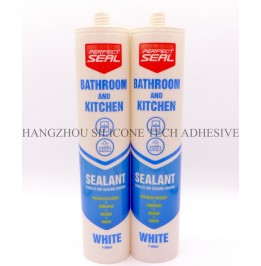
Most people blame the sealant. They buy the "mold-resistant" version, apply it, and wonder why the problem comes back within a year. The truth hits harder than you'd expect: the sealant did its job. The interface didn't. Joint sealing in wet bathrooms fails not because of what you put in the gap, but because of how you prepared and sealed the surfaces meeting at that gap.
Walk into any bathroom and look at how caulk has been applied around fixtures. Chances are you'll see a convex bead—rounded on top, thin at the edges, barely touching the substrate on either side. That shape looks neat. It also guarantees failure within months.
A proper sealant joint needs a specific profile. The bead should be slightly concave, pressed firmly into both surfaces, with maximum contact area at the bottom of the joint where water pressure is highest. Think of it like a wedge—wide at the base, narrowing toward the top. This geometry forces water down and away from the interface instead of letting it sit against the sealant-substrate boundary.
When you run a tool along a fresh bead, you're not just smoothing it for appearance. You're compressing the sealant into the joint, eliminating air pockets, and creating that critical concave shape. Skip this step and you've essentially built a raised dam that collects water on top and lets it seep underneath.
Bathrooms move. Tiles expand and contract with temperature changes. Fixtures flex slightly under weight. The building settles microscopically over time. A rigid sealant in a joint that moves will crack—and mold loves cracks.
The joint width matters enormously. Too narrow—under 3mm—and the sealant can't flex enough to absorb movement. It bonds too tightly and tears. Too wide—over 12mm—and the sealant sags, cures unevenly, and develops internal voids. The sweet spot for most bathroom applications sits between 6mm and 10mm. If your joint is wider than that, back it with a compressible foam filler first, then seal the surface.
Here's a detail that separates good work from callbacks. The joint has two sides—the vertical wall and the horizontal tub rim, for example. Most people wipe the general area with a damp cloth and call it clean. But the actual bonding surfaces, the thin strips where sealant meets substrate on both sides, need individual attention.
Use a lint-free cloth dampened with isopropyl alcohol. Wipe each surface separately, moving the cloth in one direction only—never back and forth, which just smears contamination around. Pay special attention to the bottom corner where the two surfaces meet. That inside corner collects soap scum, body oils, and mineral deposits in a way that flat surfaces don't. A cotton swab dipped in solvent works wonders for getting into tight corners where a cloth can't reach.
After wiping, let the surface dry completely. Not air-dry for five minutes and assume it's fine. Actually dry. In a humid bathroom, that can take 20 to 30 minutes. Moisture trapped at the interface will cause the sealant to cure poorly right where adhesion matters most.
Not every bathroom surface plays nice with sealant. Natural marble leaches oils that inhibit cure. Some painted walls release plasticizers. Certain plastics and acrylics have such low surface energy that sealant simply slides off.
A primer solves this—but only if applied correctly. Primer goes on thin, even coats, allowed to flash off (become tacky but not dry) before sealant application. Most primers need 15 to 30 minutes to reach that tacky state. Apply sealant while the primer is still wet and you dilute the bond. Wait too long and the primer has fully cured, losing its chemical bridging function.
The windows are narrow but real. Professionals who use primer consistently get dramatically better results than those who skip it on difficult substrates. If you're sealing a joint involving stone, painted drywall, or PVC trim, don't skip this step.
Grab a tool—a rounded spatula, a specialized sealing tool, or even a popsicle stick wrapped in tape. Press the wet sealant firmly into the joint, moving steadily along the length. The goal is to eliminate every air pocket and force the material into full contact with both substrate surfaces.
Angle the tool at roughly 45 degrees to the joint. This creates that concave profile mentioned earlier while simultaneously compressing the sealant. Move in one continuous pass if possible—stopping and restarting creates ridge lines where water collects.
The finish matters too. A slightly rough surface sheds water better than a mirror-smooth one. Micro-texture gives water droplets something to grip and roll off instead of pooling in a thin film. Mold needs sustained moisture to grow. If water beads and runs off within minutes of a shower, mold never gets the 72-hour wet window it needs to establish colonies.
For deep joints—anything over 10mm—sealant alone won't cut it. You need a backer rod or compressible foam filler to control depth and give the sealant something to bond against on the back side.
A backer rod (closed-cell polyethylene foam) sits in the joint and the sealant bonds to it on the front face only. This creates a bond-break at the back, allowing the sealant to flex freely without stressing at the deepest point. Without a backer rod, sealant in a deep joint cures against itself on the back side, creating a triple-bonded situation that can't move—and cracks when the joint shifts.
Push the backer rod in so it sits flush or slightly below the surface. Don't compress it. Then apply sealant over the top, tooling it into the rod's edge for a clean transition.
This is non-negotiable. No water on the sealant for at least 24 hours. Ideally 48. For shower floors and tub surrounds where water pressure is constant, wait 72 hours before the first shower.
The sealant is still chemically reacting during this window. Water exposure interrupts the cure, leaches uncured components out of the bead, and creates a weakened surface layer that mold colonizes almost immediately. I've seen jobs where the homeowner showered the same night because "it looked dry." By week three, black spots appeared right along the waterline.
Keep the bathroom ventilated during curing. Good airflow removes volatile byproducts and promotes even cross-linking. A fan running on low for the first day makes a measurable difference in final bond strength.
Even perfectly applied sealant needs occasional attention. Once a year, run a damp cloth along the bead and check for any spots where the sealant has pulled away from the substrate. If you find a gap—even a hairline one—clean it out, reprime if needed, and reapply a thin bead of fresh sealant.
Mold doesn't attack good sealant. It attacks the interface where sealant has separated from the surface. Catching those tiny separations early prevents them from becoming channels that funnel water behind the tile.
Don't use harsh chemicals to clean around the sealant. Bleach and ammonia-based cleaners degrade many sealant chemistries over time, making the surface brittle and porous. Mild soap and water is all you need for routine cleaning. If mold does appear despite everything, scrub with diluted white vinegar, dry thoroughly, and let the area air out for a full day before resealing.
The interface between two surfaces in a wet bathroom is the most vulnerable point in the entire waterproofing system. Get that right—the prep, the geometry, the contact, the cure—and the sealant does what it's supposed to do. Get it wrong, and no amount of anti-mold additive in the world will save you from that black line coming back.
Copyright 2019 by Hangzhou Silicone Tech Adhesive Co., Ltd. All rights reserved.
Bathroom Sealant | Acrylic Sealant | Dow Corning 795 | Aquarium Sealant | Dow Corning 732 | Clear Silicone Sealant | Polysulfide Sealant | Glazing Sealant | Mirror Sealant | IG Sealant
Powered by Onepound


