E-mail:
sales@silicone-sealant-china.com

There's a persistent myth in bathroom waterproofing that thick sealant equals better protection. People squeeze out a fat bead—sometimes 15mm or more—into a deep gap between the tub and the tile, smooth it with their finger, and walk away feeling confident. Three months later, the middle of that bead has pulled away from the tile, cracked down the center, or turned into a mold magnet.
Thick application isn't the problem. Poor technique with thick application is the problem. When done right, filling a deep joint in one or two controlled passes creates a seal that outperforms multiple thin coats in high-stress areas. The trick is understanding how sealant cures internally and managing that process so the whole depth bonds evenly instead of skinning over on top while staying gooey underneath.
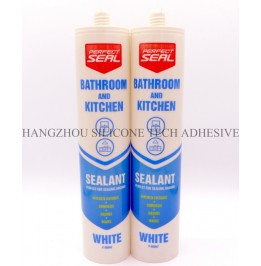
Sealant cures from the outside in. Moisture in the air reacts with the surface first, forming a skin. That skin then acts as a barrier—slowing moisture penetration to the interior. In a thin bead, say 3mm, the skin reaches the opposite surface before the material gels. Cure happens uniformly.
In a thick bead—10mm or more—the outer 2mm cures and skins while the inner 8mm is still liquid. That uncured core shrinks as it cross-links, pulling away from the already-cured shell. The result is a hollow tube of sealant bonded only at the edges, with a void running through the middle. Water gets into that void, pressure builds, and the bead delaminates from the substrate.
This is why manufacturers specify maximum joint depths. Exceeding those limits without proper technique guarantees failure. But exceeding them correctly—with the right tools and timing—works fine.
Curing is an exothermic reaction. It generates heat. In a thin bead, that heat dissipates quickly into the air and the substrate. In a thick bead, heat accumulates in the core. Temperatures can climb 10 to 15 degrees above ambient, accelerating cure unevenly and creating internal stresses.
That heat also drives off volatile components faster than they can escape through the skin. Those volatiles get trapped, forming bubbles and voids inside the bead. You won't see them from the outside—the surface looks smooth and solid. Cut the bead open a year later and it's full of honeycomb-like pockets.
Managing heat buildup is the hidden challenge of thick application. You can't eliminate it, but you can control it.
Never apply thick sealant directly into a deep gap. Always back it with a compressible foam rod—closed-cell polyethylene, the kind that doesn't absorb water. Push the rod into the joint until it sits flush with or slightly below the surface. The rod takes up the bulk of the depth, leaving maybe 3mm to 6mm of space for the sealant.
This does two things. First, it reduces the sealant thickness to a range where cure can happen uniformly. Second, it creates a bond-break at the back of the joint. The sealant cures against the rod on the front face only, leaving the back surface free to move. Without a backer rod, thick sealant cures against itself on both sides—top and bottom—creating a rigid block that cracks under any movement.
Cut the rod cleanly with a sharp knife. Don't tear it—torn edges create gaps where sealant bleeds through unevenly. Press the rod firmly into the joint so it doesn't pop out when you apply the bead.
Thick sealant oozes. It's inevitable. Masking tape on both sides of the joint keeps the bead contained and gives you a crisp edge when you peel it off. Use painter's tape—it pulls cleanly without lifting sealant off the substrate.
Press the tape down firmly, especially at corners. A tiny gap under the tape lets sealant seep underneath, and once it cures, you'll spend twenty minutes trying to scrape it off without damaging the tile. Tape well, peel carefully, and the joint looks professional.
Don't try to fill the entire depth in one squeeze. Even with a backer rod, a 6mm gap is too much for a single pass. Apply the sealant in two or three layers, letting each one skin over slightly before adding the next.
Start with the first pass—press the sealant firmly into the joint against the backer rod. Use a putty knife or spatula to pack it in, eliminating air pockets. Work slowly. Fast application traps air, and air bubbles in a thick bead are almost impossible to see but easy to feel later as soft spots.
Let the first pass skin for 15 to 30 minutes. Check by touching the surface—it should feel firm but not hard. Then apply the second pass on top. Same technique, same pressure, same care. If you need a third pass, repeat the cycle.
The total time for a thick joint might be an hour or more. That's normal. Rushing it is what causes the hollow core and the delamination.
Here's where thick application differs from thin. You tool the bead while it's still soft enough to compress but firm enough to hold shape. The window is narrow—maybe 10 to 20 minutes after the final pass, depending on temperature.
Use a rounding tool with a radius that matches the joint width. For a 10mm joint, a 10mm radius tool creates a perfect concave profile. Press the tool into the bead at a 45-degree angle, moving steadily along the joint. The compression forces sealant into the substrate surface and against the backer rod, maximizing contact area.
Don't tool too early. If the bead is still liquid, you'll just push it around without shaping it. Don't tool too late—if it's fully cured, you'll tear the surface instead of smoothing it. The sweet spot is when the bead holds its shape but still yields under finger pressure.
A thick bead that's tooled flat or convex traps water on top. The profile matters as much as the material. Press the tool deep into the joint so the sealant curves inward—like a shallow U shape. The widest point of contact should be at the bottom of the joint where water pressure pushes hardest.
This concave shape does something critical—it directs water down and away from the sealant-substrate interface. Water runs along the curve and sheds off the surface instead of sitting in a film against the material. Mold needs standing water to colonize. A properly profiled thick bead denies it that moisture.
Thick beads generate their own heat. If the bathroom is already warm—say, above 30°C—that internal heat can push core temperatures high enough to degrade the sealant. The outer layer cures normally, but the core becomes brittle or chalky.
Keep the bathroom cool during application and curing. Open a window, turn on the exhaust fan, or work in the early morning before the water heater warms the room. Ideal cure temperature for thick applications is 18°C to 24°C. Above 30°C, slow down your application speed and reduce bead thickness per pass.
Cold temperatures are the other extreme. Below 10°C, thick sealant cures so slowly that dust settles on the surface before it skins. The result is a rough, contaminated exterior that bonds poorly. If you're working in an unheated bathroom in winter, use a portable heater to keep the ambient temperature above 15°C.
Thick sealant takes longer to cure through than thin sealant. A 3mm bead might be touch-dry in an hour and fully cured in 24 hours. A 12mm bead—even with backer rod—needs 48 hours minimum before water exposure, and 72 hours is safer.
This is not optional. Water hitting a thick bead before it's fully cured interrupts the cross-linking reaction at the surface. The outer layer becomes a weak, porous skin that peels off under the slightest stress. The interior might still be curing, but the surface is already compromised.
Mark the area with tape that says "do not use for 72 hours." Tell everyone in the house. The single biggest cause of thick-bead failure is someone taking a shower too soon because the surface looked dry.
The most common place for thick sealant is where a bathtub, shower pan, or pedestal sink meets the floor. These joints are often 10mm to 20mm deep because of tile thickness, mortar beds, and fixture flanges. Thin sealant can't fill that gap—it would sag, cure unevenly, and pull away.
Backer rod plus two or three thick passes is the right call here. The joint is deep, the movement is minimal (the tub doesn't flex much), and the water exposure is constant. You need a thick, well-bonded seal that fills the entire gap and cures uniformly.
Old bathrooms rarely have perfect joints. There are chips in the tile, gaps where grout fell out, low spots where the mortar bed is uneven. These irregularities create pockets that thin sealant can't reach.
Thick application with a putty knife lets you pack sealant into those voids, pressing it into every irregularity. The putty knife acts like a trowel—scooping, pressing, smoothing. You're not just filling a gap; you're molding the sealant to the actual shape of the joint, including all its imperfections.
This is where thick application shines. Thin coats follow the surface. Thick coats conform to it.
I cannot stress this enough. Applying thick sealant without a backer rod is the fastest way to create a hollow, delaminated bead. The sealant cures against itself on both sides, can't move, and cracks under the first bit of thermal stress.
The backer rod isn't optional for deep joints. It's structural. It controls depth, prevents three-sided bonding, and gives the sealant room to flex. Every professional installer uses backer rod on joints deeper than 6mm. If someone tells you otherwise, they've either never had a callback or they're cutting corners.
Thick beads need firm tooling—but not brutal tooling. Pressing too hard with a metal tool can compress the sealant so much that it pulls away from the substrate on one side. You end up with full contact on the top edge and zero contact on the bottom, which is exactly backwards.
Use even, steady pressure. Let the tool do the work—don't muscle it. The sealant should compress about 20% to 30% of its wet thickness during tooling. That's enough to create the concave profile and maximize contact without displacing material from the bond line.
If you apply the second pass before the first one skins, the two layers mix instead of bonding. You get a marbled mess instead of a laminated structure. If you wait too long and the first pass fully cures, the second pass won't bond—it'll sit on top like a separate bead.
That window—skin-over but not fully cured—is maybe 20 to 40 minutes depending on conditions. Learn to read it by touch. The surface should feel firm, like a rubber band that's been stretched and released. Not tacky, not hard. Firm.
A properly applied thick bead ages differently than a thin one. Because it's bonded across the full depth—not just at the surface—it resists peeling forces much better. When the joint moves slightly from building settlement or thermal cycling, the thick bead flexes as a unit instead of delaminating in layers.
The downside is that if it fails, it fails catastrophically. A thin bead might peel back gradually, giving you time to catch it. A thick bead that loses adhesion across the whole depth comes off in one piece, taking whatever was behind it with it. That's why preparation matters even more with thick application—you can't afford any weak points.
In high-water-pressure zones—like the base of a shower wall where water runs down constantly—thick beads hold up better. The extra mass resists being pushed out of the joint by water pressure. Thin beads in these locations get forced out over time, creating gaps at the top of the joint.
Thick beads also handle UV exposure better if any part of the joint sees indirect sunlight. More material means slower degradation. In a bathroom, this matters less than in a kitchen, but for bathroom windows or skylight-adjacent joints, thickness adds durability.
The real win for thick application is in joints that don't move much but see constant water. Tub-to-floor, sink-to-counter, tile-to-floor transitions—these are the spots where thick, well-cured sealant outperforms thin coats every time.
Getting a thick bead right takes more time, more patience, and more attention to curing conditions than thin application. But when the joint is deep, the gap is irregular, or the water exposure is relentless, there's no substitute for proper thick-fill technique. Skip the backer rod, rush the cure, or tool it wrong, and you've wasted the material and the effort. Do it right, and that thick bead will outlast everything else in the bathroom.
Copyright 2019 by Hangzhou Silicone Tech Adhesive Co., Ltd. All rights reserved.
Bathroom Sealant | Acrylic Sealant | Dow Corning 795 | Aquarium Sealant | Dow Corning 732 | Clear Silicone Sealant | Polysulfide Sealant | Glazing Sealant | Mirror Sealant | IG Sealant
Powered by Onepound


