E-mail:
sales@silicone-sealant-china.com

Nobody talks about the toilet base seal. It sits in the corner, hidden behind the bowl, out of sight and out of mind—until it fails. Then you're standing in wet socks, pulling up baseboards, and discovering that the entire floor under the toilet is soft and black with mold.
The toilet base is the single most important seal in any bathroom. It handles the full weight of the fixture, constant water exposure from the tank, temperature swings from hot bathroom floors, and physical stress every time someone sits down. Yet most homeowners slap a bead of silicone around the base in ten seconds and hope for the best.
That bead fails within months almost every time. Not because silicone is bad—because the method is wrong. Sealing a toilet base requires a specific approach that accounts for the fixture's weight, the flange's position, and the fact that this joint moves every single day.
A toilet weighs between 70 and 140 pounds depending on the model. That weight sits directly on the flange—the plastic or metal ring bolted to the floor. Every time someone sits, the toilet rocks slightly on that flange. That rocking motion shears the sealant at the base.
Most people apply a single thick bead around the entire perimeter. When the toilet rocks, that thick bead cracks right at the stress point—usually the front where the rocking is most pronounced. Water wicks into the crack, runs down the flange, and soaks into the subfloor. By the time you notice the smell, the damage is done.
The fix isn't using a better sealant. It's using the right geometry and the right technique to handle the movement.
Traditional toilets use a wax ring between the bowl outlet and the flange. That wax ring handles the bowl-to-flange seal. But the flange-to-floor seal—where the flange meets the finished flooring—is where most leaks actually happen. People assume the wax ring protects everything. It doesn't. Water gets past the wax ring and pools around the flange base.
That's where your sealant goes. Not around the bowl. Around the flange. The joint you're sealing is between the flange and the floor, not between the toilet and the floor.
Pull the toilet away from the wall. You'll need a helper or a sturdy piece of wood to lever it without cracking the porcelain. Set it on an old towel to protect the finish.
Once it's off, you'll see the old sealant bead, the wax ring (if it's a standard installation), and probably some mold or mildew around the flange. Scrape away every trace of old sealant with a putty knife. Don't leave any—even a thin film of old material prevents the new sealant from bonding to the substrate.
Clean the flange and the surrounding floor with isopropyl alcohol. Wipe the flange itself, the floor surface, and the area where the flange meets the subfloor. If there's mold, scrub it with diluted vinegar first, then alcohol. Let everything dry completely—at least 30 minutes, longer if the floor is porous.
Check the flange for damage. If it's cracked, warped, or the bolts are rusted, replace it before sealing. No amount of sealant fixes a bad flange. The flange is the foundation of the entire seal system.
If the toilet rocks when you sit on it, the flange is either too high, too low, or off-center. A rocking toilet destroys any seal within weeks. Before you apply a single drop of sealant, make sure the toilet sits level and stable.
Shim the flange if it's too low. Use plastic shims—not cardboard, not wood. Cardboard absorbs moisture and rots. Wood swells and cracks. Plastic shims last indefinitely under a toilet.
If the flange is too high, you might need to cut it down or use a thinner wax ring. If it's off-center, reposition it if the subfloor allows. Getting the toilet stable before sealing is non-negotiable.
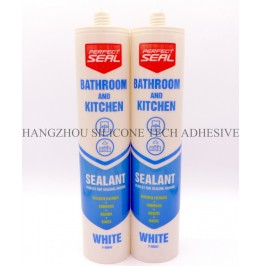
Not every sealant works at a toilet base. You need something with high movement capability—at least 25% elongation. Standard bathroom silicone works, but a polymer-modified sealant or a polyurethane-based product handles the rocking motion better.
Avoid pure silicone in joints that move constantly. It bonds too rigidly and cracks under repeated stress. Look for products labeled for "high movement" or "sanitary" applications. The key is flexibility, not hardness.
Also make sure it's compatible with your flooring material. Most sealants work on tile and vinyl, but natural stone and some engineered woods need specific formulations. When in doubt, test a small bead in an inconspicuous spot and wait 24 hours before committing.
Start at the back of the toilet—the side against the wall. Run a thin, even bead of sealant around the entire base of the flange where it meets the floor. The bead should be about 3mm to 5mm thick and pressed firmly into the joint.
Use a wet finger or a small rounded tool to smooth the bead as you go. Create a slight concave profile—pressed into the joint at the bottom, tapering at the edges. This shape directs water away from the seal line instead of letting it pool against the flange.
Don't apply sealant between the toilet bowl and the flange—that's the wax ring's job. Your sealant goes only where the flange meets the floor. Keep the two systems separate. Mixing them creates confusion about where the actual seal is and makes future repairs a nightmare.
If the gap between the flange and the floor is more than 6mm deep—common with thick tile or raised flooring—push a backer rod into the joint first. Cut it to length, press it flush with the floor surface, then apply sealant over it.
The backer rod controls depth and prevents the sealant from bonding to the bottom of the joint. Without it, thick sealant cures against the subfloor on all sides and can't flex when the toilet rocks. With the rod, the sealant bonds only to the flange and the floor surface, free to move.
With the sealant applied, slide the toilet back into position. Align the bolt holes with the flange and press down firmly. Don't rock it side to side—press straight down. You want the flange to compress the sealant evenly around its entire circumference.
If sealant squeezes out from under the flange, that's good. It means the joint is fully filled. Wipe away the excess with a damp cloth before it skins over. Don't let excess sealant cure—it becomes a mess that's hard to remove later and creates a ridge where dirt collects.
Tighten the bolts alternately—front left, back right, front right, back left—to keep the toilet centered as you tighten. Don't overtighten. Cracking the porcelain to squeeze out more sealant defeats the purpose.
After the toilet is seated and the excess is wiped, you'll have a visible bead of sealant around the flange. Tool this bead with a wet finger or a small spatula. Press it into the joint between the flange and the floor, creating that concave shape.
The finished bead should look like a smooth, continuous line hugging the flange. No gaps, no ridges, no air pockets. If you see any pinholes or thin spots, add a small amount of fresh sealant and re-tool those areas.
This exposed bead is your inspection point. If it cracks later, you'll see it immediately. If it stays intact, the seal is doing its job.
Do not sit on that toilet for at least 24 hours. Ideally 48. The sealant needs full cure time before any weight or movement stresses the joint. I know it's inconvenient—use another bathroom if you have one.
During the cure period, keep the bathroom ventilated. A fan on low helps remove volatile byproducts and promotes even cross-linking. Don't close the bathroom door completely—airflow matters.
Temperature affects cure time. At 20°C, most sealants are touch-dry in 2 to 4 hours and fully cured in 24 hours. At 10°C, double that time. At 30°C, the surface cures fast but the interior stays soft longer. When in doubt, wait the full 48 hours.
Once the cure time is up, inspect the bead. Run your finger along it—it should feel firm, smooth, and bonded to both the flange and the floor. No soft spots, no gaps, no areas where it pulls away.
Flush the toilet ten times. Watch the bead as water runs through the system. If the bead flexes slightly without cracking, it's working. If you see any separation at the flange edge, the toilet rocks too much, or the flange wasn't level—go back and fix the root cause before resealing.
Check the toilet base seal every three months for the first year. Look for cracking, softening, gaps, or mold. After the first year, monthly checks are enough unless you notice a smell or dampness.
If the bead starts cracking at the front—where the toilet rocks most—that's a sign the movement is too much for the sealant. You might need a more flexible product or a shim under the flange to reduce rocking.
Never ignore a cracked bead at a toilet base. Water gets behind that crack fast. The subfloor absorbs it silently. By the time you see damage on the ceiling below or the cabinet beside the toilet, the repair involves removing the toilet, cutting out rotted flooring, and starting over.
A toilet base seal takes twenty minutes to do right. The repair for a failed one takes two days and costs ten times more. Get the prep right, use the right material, apply it in the right shape, and let it cure properly. That's all there is to it.
Copyright 2019 by Hangzhou Silicone Tech Adhesive Co., Ltd. All rights reserved.
Bathroom Sealant | Acrylic Sealant | Dow Corning 795 | Aquarium Sealant | Dow Corning 732 | Clear Silicone Sealant | Polysulfide Sealant | Glazing Sealant | Mirror Sealant | IG Sealant
Powered by Onepound


