E-mail:
sales@silicone-sealant-china.com

That glass partition in your shower looks sleek and clean. The metal columns holding it up seem solid enough — bolted to the floor, braced at the top, done. But look closely at the base of each column where it meets the tile or the floor. There is almost always a gap. Water runs down the glass, hits the column base, and pools right there. If there is no sealant, that water seeps under the column base, into the floor, and into the subfloor below. Over time, the column starts to wobble, the sealant pulls away, and the whole partition looks like it is falling apart.
Sealing the base of every partition column takes five minutes per post and saves you from a repair job that costs ten times more. Most people skip it. That is a mistake.
Every vertical column in a bathroom partition — whether it is metal, aluminum, or stainless steel — has the same weak point: the bottom. The column sits on a flat base plate that is screwed or bolted to the floor. But the base plate never sits perfectly flat against the tile. Tile surfaces are uneven. Grout lines create ridges. The base plate bridges over those imperfections, which means there are tiny gaps along the edges where water can get in.
Shower water runs down the glass and drips off the bottom edge. It collects right at the column base. If there is no sealant, that water sits there every single day. It seeps behind the base plate, soaks into the grout, and slowly works its way down into the subfloor. You do not notice until the floor feels soft, the tile starts to lift, or the column wobbles when you push on it.
The top of the column is another trouble spot. Most partitions are braced at the top with a horizontal bar or a wall-mounted bracket. The joint where the vertical column meets that horizontal brace is almost never sealed. Water runs down the inside of the brace, hits the joint, and drips right behind the column. Over time, that moisture rots the wall behind the partition and weakens the entire assembly.
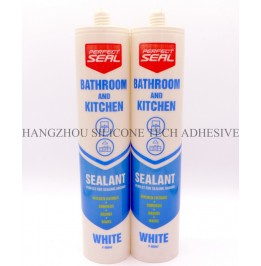
Metal partition columns — aluminum, stainless steel, chrome-plated steel — bond reliably to silicone sealant. Silicone sticks to metal, stays flexible for years, and handles constant water exposure without breaking down.
Neutral-cure silicone is the better pick here. Acetoxy silicone smells like vinegar when it cures, and that smell can linger in a small bathroom for days. More importantly, acetoxy silicone can corrode certain metal finishes over time, especially brushed nickel and matte black. Neutral-cure silicone has no smell, bonds better to painted walls, and is gentler on metal surfaces.
Pick a silicone with at least 250 percent elongation. That rating tells you how much the sealant can stretch before it breaks. Partition columns vibrate slightly every time someone slams the shower door. A low-elongation silicone cracks under that repeated stress. A high-elongation silicone flexes with it and stays intact.
If your partition columns sit on a floor that is not perfectly level — which is most bathroom floors — polyurethane sealant might outperform silicone. Polyurethane bonds more aggressively to both metal and tile, and it handles physical stress better than silicone.
When the floor shifts slightly or the column gets bumped, polyurethane holds the bond where silicone might slowly peel away. It is also more abrasion-resistant, which matters if the column base gets scraped by a shower mat or a dropped bottle.
Hybrid sealants give you both adhesion and flexibility in one product. For partition columns that need to stick to metal, tile, and painted walls while staying elastic under constant movement, hybrids are a strong option.
Stay away from acrylic latex caulk on partition columns. It is not waterproof, it shrinks as it dries, and it will pull away from the metal base within weeks. It has no business anywhere near a shower partition.
This is the step that makes or breaks the job. If you try to seal around a column that is still bolted to the floor, you cannot get a proper bead along the bottom edge. The base plate presses against the tile, the sealant gets squeezed out unevenly, and you end up with a messy, incomplete seal.
Unbolt the column. Lift it off the floor. Lay it on a towel. Now you have full access to the base plate and the floor surface underneath. You can clean both surfaces properly, apply sealant evenly, and press the bead into both the plate and the tile.
If the column is heavy or awkward to move, at least tilt it away from the wall enough to get your caulk gun into the gap. But removing it entirely gives you the best result.
Scrape off any old sealant, adhesive, or caulk from the bottom of the base plate and the tile surface. Use a plastic putty knife — a metal blade can scratch polished metal finishes. Get into every corner, every edge, every spot where old material has accumulated.
Wipe both surfaces with isopropyl alcohol. Not soapy water. Isopropyl alcohol cuts through grease, removes soap scum, and evaporates completely, leaving a perfectly clean surface for bonding. Let everything dry for at least 20 minutes.
If the tile or grout around the column base shows signs of water damage — soft grout, discoloration, or crumbling — repair it before you reattach the column. Sealing over a damaged surface just traps moisture behind the plate and makes the problem worse.
Most metal columns do not need primer, but if the finish is smooth or anodized, a metal primer creates a better bond. Apply the primer to the bottom of the base plate, let it dry, then apply your sealant.
If the column sits against a painted wall, prime the wall surface at the joint. Primer creates a chemical bridge between the sealant and the paint, especially on walls that have been painted multiple times. Skipping primer on painted surfaces is one of the fastest ways to get a failed seal.
Do not just seal the front edge of the column base. Run a continuous bead of sealant around the entire perimeter — front, back, left, right, all the way around. Water can get in from any direction. A spot seal on one edge leaves the rest exposed, and moisture will find those gaps.
The bead should be about 4 to 6 millimeters wide and deep. Thin enough to tool smoothly, thick enough to fill the gap completely. If the gap between the base plate and the tile is wider than 6 millimeters, stuff a foam backer rod into the joint first. The backer rod controls the depth of the bead and gives the sealant something to bond to.
After applying the sealant, press it firmly into both the base plate and the tile. Use your finger or a small sealant tool and work the bead into a smooth, concave shape — like a shallow bowl that slopes away from the column.
The concave shape matters. It directs water away from the column base instead of letting it pool against the sealant line. A flat or convex bead traps water, and trapped water is the fastest path to a failed seal.
Wipe your tool with a damp cloth between passes. Work quickly — most sealants begin skinning over within 10 to 15 minutes, and once that happens, you cannot tool it properly anymore.
Most sealants need 24 to 48 hours to cure fully. During that time, do not put the column back in place. Do not lean on it, do not bump it, do not even touch it. Let the sealant bond to both surfaces without any stress.
If you reinstall the column before the sealant cures, you pull the bead away from the tile and create a gap. The sealant will bond to the column but not to the floor, and the whole thing fails from the floor side.
Most people seal the bottom of the column and completely forget about the top. The joint where the vertical column meets the horizontal brace or wall-mounted bracket is just as vulnerable as the base.
Water runs down the inside of the brace, hits the joint, and drips right behind the column. Over time, that moisture rots the wall and weakens the entire partition assembly.
Remove the column again if needed, and run a thin bead of sealant around the entire perimeter of the top joint. Press it firmly into both the column and the brace, tool it smooth, and let it cure fully before reassembling.
The joint where the metal column meets the glass panel is another spot that gets ignored. Even if the glass is set in a channel, there is usually a tiny gap where water can seep behind the panel.
Run a thin bead of clear or color-matched silicone along the inside edge where the glass meets the column. Apply it in thin layers, tool it smooth, and make sure the bead fully encircles the glass at the column connection.
Bathroom partition columns take a beating. Water, steam, cleaning chemicals, and physical bumps all stress the sealant over time. Check every column base at least twice a year. Run your finger along the sealant bead and feel for any cracks, gaps, or rough spots.
If the sealant feels hard and brittle instead of soft and flexible, it has lost its elasticity and needs to be replaced. If you see any water staining on the tile or floor around the column base, do not wait — re-seal immediately.
When re-sealing, always remove the old sealant completely. Do not apply new sealant over old sealant. Scrape it off both the base plate and the tile, clean the surfaces with isopropyl alcohol, reprime if needed, and apply fresh sealant in thin layers. Patching over a failed bond with new sealant just delays the inevitable.
One more thing that helps: keep the bathroom ventilated. An exhaust fan removes moisture before it has a chance to condense on the partition columns and attack the sealant. Sealant handles the water that gets in. A fan keeps the moisture from building up in the first place. Use both, and your partition columns stay solid and mold-free for years.
Copyright 2019 by Hangzhou Silicone Tech Adhesive Co., Ltd. All rights reserved.
Bathroom Sealant | Acrylic Sealant | Dow Corning 795 | Aquarium Sealant | Dow Corning 732 | Clear Silicone Sealant | Polysulfide Sealant | Glazing Sealant | Mirror Sealant | IG Sealant
Powered by Onepound


