E-mail:
sales@silicone-sealant-china.com

That drop ceiling above your bathroom looks clean and finished. Tight panels, straight lines, no gaps. Except there are always gaps. Between the panels, around the edges where the ceiling meets the wall, near the light fixture, and around the exhaust fan housing. Those gaps are tiny — maybe a millimeter or two — but they are enough to let steam, moisture, and even small pests creep into the space above the ceiling.
Most people never think about sealing a bathroom drop ceiling. They figure the panels sit tight enough and that is that. But over time, those unsealed gaps become highways for moisture. Condensation builds up above the panels. Mold grows on the back side of the ceiling. The panels start to sag, discolor, or fall down entirely. A proper sealant job takes twenty minutes and prevents all of that.
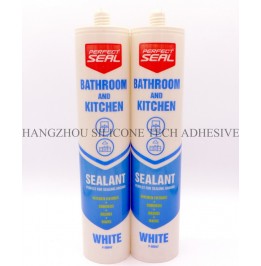
The space above a bathroom drop ceiling is not a dead zone. It is full of pipes, wiring, ductwork, and insulation. When hot water runs in the shower below, steam rises and hits the cold ceiling panels. That steam condenses on the back side of the panels and drips down onto whatever is up there.
If the gaps between panels are not sealed, that moisture migrates freely across the entire ceiling cavity. It soaks into insulation, corrodes metal ductwork, and creates the perfect environment for mold. You might not see it for months, but one day you will notice a brown stain on a panel, a musty smell when the exhaust fan is off, or a panel that has started to bow in the middle.
The edges where the ceiling meets the wall are even worse. That joint runs the entire perimeter of the bathroom, and it is almost never sealed properly during installation. Warm, moist air from the shower pushes against that joint, and if there is no sealant, the air — and the moisture it carries — slips right behind the ceiling.
Most bathroom drop ceilings are made from PVC, aluminum, or fiberglass-reinforced panels. Each of these materials bonds differently to sealant, so picking the right type matters.
PVC panels bond well with silicone, but they need a neutral-cure formula. Acetoxy silicone smells like vinegar and can actually damage PVC over time, causing it to become brittle and discolor. Neutral-cure silicone has no smell, bonds reliably to PVC, and stays flexible for years.
Aluminum panels work best with a silicone that includes a metal primer or a polyurethane sealant. Pure silicone slides off bare aluminum pretty easily, especially when the surface is smooth or anodized. A primer creates a chemical bond that keeps the sealant in place.
Fiberglass panels are the easiest to seal — pretty much any good-quality silicone will stick to them. But fiberglass absorbs moisture over time, so the sealant needs to stay flexible enough to move with the panel as it expands and contracts.
Some gaps in a drop ceiling are awkward to reach — the corners where panels meet the wall, the spots around light fixtures, or the seams near the exhaust fan housing. Hybrid sealants are easier to apply in these tight spots because they tool more smoothly and bond to a wider range of surfaces than pure silicone.
Hybrids also tend to have better paintability if you ever need to touch up the sealant line. Pure silicone is hard to paint over and usually does not hold paint well. If your ceiling panels are white and you want the sealant to blend in, a paintable hybrid is the smarter choice.
Avoid acrylic latex caulk on ceiling gaps. It is not waterproof, it shrinks as it dries, and it will pull away from the panel edges within weeks. It belongs on dry interior trim, not in a bathroom ceiling.
Dust, grease from fingers, and old adhesive residue all prevent sealant from bonding. If you just run a bead of sealant over a dirty edge, it will look fine for a week and then peel right off.
Wipe every edge where sealant will go with isopropyl alcohol. Not water, not soapy water — isopropyl alcohol. It cuts through grease, removes dust, and evaporates completely, leaving a clean surface for bonding. Let everything dry for at least 15 minutes before you apply anything.
If there is old sealant or caulk on the panel edges, scrape it off completely. Use a plastic putty knife so you do not scratch the panel surface. Any leftover old material creates a weak layer, and the new sealant will sit on top of it instead of bonding to the actual panel.
Before you seal anything, run your hand across every panel. If a panel is soft, warped, or already showing water stains, sealing the gaps will not fix the problem. The panel itself needs to be replaced.
Sealing around a damaged panel just traps moisture behind it and makes the problem worse. Replace any compromised panels first, then seal the gaps on the good ones.
Most people only seal the obvious gaps between panels. That helps, but it is not enough. The real trouble spots are the perimeter joints where the ceiling meets the wall, the seams around light fixtures, and the edges near the exhaust fan.
Run a thin bead of sealant along every joint — panel-to-panel, panel-to-wall, panel-to-fixture. A continuous bead around the entire perimeter gives you full protection. Skipping the wall joints leaves the biggest entry point for moisture completely exposed.
The bead should be about 3 to 4 millimeters wide and deep. Thin enough to tool smoothly, thick enough to fill the gap completely.
If the gap between two panels is very narrow — under 4 millimeters — you can apply sealant directly. But if the gap is wider, stuff a thin foam backer rod into the joint first.
The backer rod controls the depth of the sealant bead and gives it something to bond to. Without it, you end up using too much sealant, it takes forever to cure, and the center of the bead stays soft for days. A backer rod also creates a concave shape that directs any moisture away from the joint instead of trapping it.
Cut the rod to length, press it firmly into the gap so it sits flush with the panel surface, and then apply your sealant on top.
After applying the sealant, tool it into a smooth bead that sits flush with the panel surface. Use a wet finger or a small sealant tool and press the sealant firmly into both panel edges.
The goal is a bead that is slightly concave — like a shallow channel — so water runs along it instead of pooling on top. A flat or convex bead traps water, and trapped water eventually finds its way under the sealant.
Wipe your tool with a damp cloth between passes. Work quickly — most sealants begin skinning over within 10 to 15 minutes, and once that happens, you cannot tool it properly anymore.
The exhaust fan cuts a hole right through the ceiling, and that opening is one of the biggest moisture entry points in the entire bathroom. Warm, steamy air gets sucked up through the fan, and if the joint between the fan housing and the ceiling panels is not sealed, that moist air escapes into the ceiling cavity.
Use a high-movement silicone or a hybrid sealant around the entire perimeter of the fan housing. Apply it in thin layers over a backer rod, tool it smooth, and make sure the bead fully encircles the housing. Do not leave any gaps.
Check this joint every three to four months. The fan vibration loosens sealant faster than anywhere else in the ceiling, and a small gap here can flood the entire ceiling cavity within weeks.
The perimeter joint where the drop ceiling meets the wall is the most neglected seal in any bathroom. Installers often skip it because it is hard to reach and nobody can see it once the ceiling is up.
But that joint runs the entire room, and it is the primary path for moist air to get behind the ceiling. Run a continuous bead of sealant along the entire perimeter — every wall, every corner, every edge. Use a backer rod if the gap is wide, apply in thin layers, and tool it smooth.
This is the single most important sealant job on the entire ceiling. Get it right, and everything else becomes secondary.
Light fixtures cut holes in the ceiling panels, and those cutouts are rarely sealed properly. The gap between the fixture housing and the panel edge lets warm air rise straight into the ceiling cavity.
Remove the light cover if possible, and run a bead of sealant around the entire perimeter of the cutout. Use a neutral-cure silicone that bonds well to the panel material. Press it firmly into both the panel edge and the fixture housing, tool it smooth, and let it cure fully before putting the cover back on.
Bathroom ceilings take a beating from steam, heat, and cleaning chemicals. Even the best sealant job has a lifespan — usually three to five years in a bathroom setting. After that, the sealant starts losing flexibility, cracks form, and moisture gets in again.
Check every ceiling gap at least twice a year. Run your finger along the sealant bead and feel for any cracks, gaps, or rough spots. If the sealant feels hard and brittle instead of soft and flexible, it needs to be replaced.
When re-sealing, always remove the old material completely. Do not apply new sealant over old sealant. Scrape it off both surfaces, clean with isopropyl alcohol, reprime if needed, and apply fresh sealant in thin layers.
One thing that makes a huge difference: keep the bathroom ventilated. An exhaust fan removes moisture before it has a chance to rise into the ceiling cavity. Sealant handles the moisture that gets past the fan. The fan keeps the moisture from building up in the first place. Use both, and your drop ceiling stays dry and mold-free for years.
Copyright 2019 by Hangzhou Silicone Tech Adhesive Co., Ltd. All rights reserved.
Bathroom Sealant | Acrylic Sealant | Dow Corning 795 | Aquarium Sealant | Dow Corning 732 | Clear Silicone Sealant | Polysulfide Sealant | Glazing Sealant | Mirror Sealant | IG Sealant
Powered by Onepound


