E-mail:
sales@silicone-sealant-china.com

Your bathroom window sill looks like it should be the easiest surface in the room to maintain. It is just a flat piece of stone sitting there, right? Wrong. That sill takes more abuse than almost anything else in your bathroom. Rain hits it from the outside. Condensation builds up on it from the inside. Wind pushes moisture right into every tiny gap between the stone and the wall. And if the sealant around that joint has failed — which it almost certainly has — water is creeping behind the stone, into the wall, and into your drywall right now.
Most people never think about sealing a bathroom window sill until they notice a water stain on the wall below or feel the stone shifting when they press on it. By then, the damage is already done. Fixing it properly takes maybe fifteen minutes and saves you from pulling out tiles and replacing rotted framing later.
A window sill in a bathroom sits at the intersection of two completely different environments. On the outside, it deals with rain, wind, and temperature swings that can be brutal. On the inside, it sits in a steam-filled room where condensation forms on every cold surface — including that stone sill.
The joint where the stone meets the wall is the weak link. Stone is rigid. Walls move slightly with temperature and humidity changes. That differential movement puts constant stress on whatever sealant you used. A rigid sealant cracks. A flexible one survives — but only if it was applied correctly in the first place.
Wind is the other problem most people overlook. Even a small breeze can push rainwater sideways under a poorly sealed sill. The water does not need to come straight down. It just needs to find a gap, and wind will drive it right in. Once water gets behind the stone, it has nowhere to go. It pools, it soaks into the drywall, and it starts rotting the wall from the inside out.
The stone itself can also be a culprit. Natural stone is porous. It absorbs water like a sponge, and that moisture wicks into the sealant joint, accelerating breakdown from both sides. Even engineered stone has micro-pores that trap moisture over time.
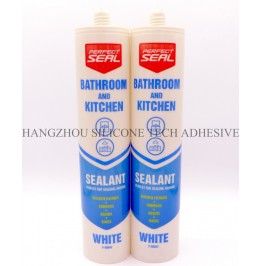
Silicone sealant is the go-to for window sill sealing because it is fully waterproof and stays flexible for years. But not every silicone handles wind-driven rain the same way.
You need a high-movement silicone — one rated for at least 25 percent elongation. That number tells you how much the sealant can stretch before it breaks. The higher the number, the better it handles the movement between rigid stone and a wall that shifts with humidity.
Acetoxy silicone cures fast and bonds well to stone and tile. But it smells like vinegar and can corrode certain metal window frames over time. Neutral-cure silicone has no smell, bonds better to painted walls, and is gentler on metal frames. For a bathroom window sill, neutral-cure is almost always the safer pick.
If the sill sits in a spot where wind-driven rain is a real issue — say a ground-floor bathroom or one facing a prevailing wind direction — look for a silicone specifically rated for exterior exposure. These formulations resist UV degradation and stay flexible in freezing temperatures, which matters when cold wind hits the outside of the sill.
Polyurethane sealant bonds more aggressively than silicone to both stone and painted walls. If your sill has been leaking for a while and the wall behind it is painted drywall, polyurethane might outperform silicone because it grips painted surfaces better.
Hybrid sealants give you the best of both worlds. They flex like silicone and bond like polyurethane. For a window sill where the stone meets a painted wall and the joint is exposed to both wind and steam, hybrids are often the most reliable long-term choice.
Skip acrylic latex caulk completely. It is not waterproof, it shrinks as it dries, and wind will blow it right out of the joint within weeks. It has no place on a bathroom window sill.
This is non-negotiable. If there is any old sealant left in the joint — even a thin film — the new sealant will not bond to the actual surfaces. It will bond to the old layer, and the old layer will peel off, taking the new stuff with it.
Use a plastic putty knife or a silicone removal tool. Get into every corner where the stone meets the wall. If the old sealant is stubborn, soak it with isopropyl alcohol for 10 minutes to soften it, then scrape again.
Be careful with natural stone. Do not use a metal blade or a razor near the edge — one slip and you have a chip that is nearly impossible to fix.
Water does not clean a sealant surface properly. It leaves behind moisture that prevents adhesion. Soapy water is even worse — the surfactant residue acts like a release agent.
Use isopropyl alcohol. Wipe the entire joint where the stone meets the wall, the top surface of the sill, and the wall surface above and below the joint. Let it dry completely — at least 20 minutes — before you touch a caulk gun.
If you see mold or mildew in the joint, kill it first. A diluted bleach solution or white vinegar works fine. Scrub it out with an old toothbrush, rinse thoroughly, and dry the area before sealing.
Most stone does not need primer. But if the wall behind the sill is painted drywall, a primer coat makes a massive difference. Primer creates a chemical bridge between the sealant and the painted surface, especially on walls that have been painted multiple times.
Apply the primer to the wall surface on both sides of the joint, let it dry according to the instructions, and then apply your sealant on top. Skipping primer on a painted wall is one of the fastest ways to get a failed seal.
Most people only seal the inside edge where the sill meets the wall. That is the most visible spot, but it is not the only one that matters. Wind drives rain under the sill from the outside. If you do not seal the outside edge, water gets in from the back door.
Run a continuous bead of sealant along the entire perimeter of the joint — inside edge, outside edge, and both sides where the stone meets the wall. A full perimeter seal gives you complete protection. Spot-sealing one or two edges leaves the rest exposed, and water will find those gaps.
The bead should be about 4 to 6 millimeters wide and deep. Thin enough to tool smoothly, thick enough to fill the joint completely.
If the gap between the stone and the wall is narrow — under 5 millimeters — you can apply sealant directly. But if the gap is wider, stuff a foam backer rod into the joint first.
The backer rod controls the depth of the sealant bead and gives it something to bond to. Without it, you end up using too much sealant, it takes forever to cure, and the center of the bead stays soft for days. A backer rod also creates a concave shape that directs water away from the joint instead of trapping it.
Cut the rod to length, press it firmly into the gap so it sits flush with the stone surface, and then apply your sealant on top.
After applying the sealant, tool it into a smooth bead that slopes slightly away from the stone. Use a wet finger or a small sealant tool and press the sealant firmly into both the stone and the wall.
The slope matters. A bead that slopes away from the stone directs water toward the outside instead of letting it pool against the joint. A flat or inward-sloping bead traps water, and trapped water is the fastest path to a failed seal.
Wipe your tool with a damp cloth between passes. Work quickly — most sealants begin skinning over within 10 to 15 minutes, and once that happens, you cannot tool it properly anymore.
The joint between the stone sill and the window frame is one of the most critical spots in the entire assembly. Water runs down the window glass, hits the frame, and pools right at the junction with the sill. If that joint is not sealed, water gets behind the frame and into the wall.
Use a high-movement silicone or a hybrid sealant at this joint. Apply it in thin layers over a backer rod, tool it smooth, and make sure the bead fully encircles the frame-to-sill connection. Do not leave any gaps.
The outside edge of the sill is where wind-driven rain attacks hardest. This edge needs a continuous bead of sealant that bonds to both the bottom of the stone and the exterior wall surface.
Use a silicone rated for exterior exposure. Apply it generously — this is not a spot to skimp. The bead should be at least 5 millimeters thick and should slope outward so water runs off the sill instead of pooling at the joint.
Check this edge every few months. The outside of the sill takes more punishment than the inside, and the sealant degrades faster from UV exposure and temperature swings.
Corners are where sealant fails first. The two surfaces meet at an angle, which makes it hard to get a continuous bead. Most people rush through the corners and end up with thin, weak spots that crack within months.
Slow down at the corners. Apply a slightly thicker bead than you would on a straight edge, and press it firmly into both surfaces. Use your finger to round the bead into the corner so there are no sharp edges where water can collect.
Bathroom window sills live in a brutal environment. Wind, rain, steam, cleaning chemicals, and temperature swings all attack the sealant every single day. Even the best sealant job has a lifespan — usually three to five years in a bathroom setting.
Check the sealant at least twice a year. Run your finger along the entire perimeter and feel for any cracks, gaps, or rough spots. If the sealant feels hard and brittle instead of soft and flexible, it has lost its elasticity and needs to be replaced.
If you find a small gap, do not just add more sealant on top. Remove the old material from that section, clean the surfaces with isopropyl alcohol, reprime if needed, and apply fresh sealant in thin layers. Patching over a failed bond with new sealant just delays the inevitable.
When cleaning the sill, avoid pouring harsh chemicals directly onto the sealant line. Bleach, ammonia, and strong acids can break down silicone over time. Use mild soap and water instead, and keep abrasive scrubbers away from the joint.
One more thing that makes a huge difference: if your bathroom window does not have a proper weather seal on the frame itself, no amount of sill sealant will keep the water out. The frame seal and the sill seal work together. If the frame is leaking, the sill seal is doing double duty and will fail faster. Fix the frame first, then seal the sill. Both need to be tight for the whole system to work.
Copyright 2019 by Hangzhou Silicone Tech Adhesive Co., Ltd. All rights reserved.
Bathroom Sealant | Acrylic Sealant | Dow Corning 795 | Aquarium Sealant | Dow Corning 732 | Clear Silicone Sealant | Polysulfide Sealant | Glazing Sealant | Mirror Sealant | IG Sealant
Powered by Onepound


