E-mail:
sales@silicone-sealant-china.com

That towel bar on your bathroom wall. The toilet paper holder. The robe hook by the door. They all look solid enough, screwed right into the wall with anchors and brackets. But look closer — there is almost always a tiny gap where the base plate meets the tile or wall surface. Water gets in there every single day. It pools, it sits, it slowly eats away at the wall behind the plate, and one morning the whole thing rips off the wall and takes a chunk of drywall with it.
Sealing the base of every bathroom hardware piece is one of those jobs that takes five minutes per fixture and prevents a disaster that costs ten times more to fix. Most people skip it entirely. That is a mistake.
Every bathroom fixture that mounts to the wall has the same problem. The base plate sits flat against the wall, but it never sits perfectly flat. Tile surfaces are uneven. Drywall has texture. Paint adds another layer of irregularity. So even when you tighten the screws down, there are micro-gaps between the base plate and the wall — usually along the bottom edge where gravity pulls water downward.
Shower steam condenses on cold metal hardware. That moisture runs down the fixture and collects right at the base. If there is no sealant, that water seeps behind the plate and into the wall. Over months, the drywall softens. The anchors lose their grip. The fixture starts to wobble. Eventually it comes crashing down — usually at two in the morning when someone leans on the towel bar to steady themselves.
The failure always starts at the base. Never at the top. Water works its way down, not up. That is why the bottom edge of every hardware base needs a proper sealant bead.
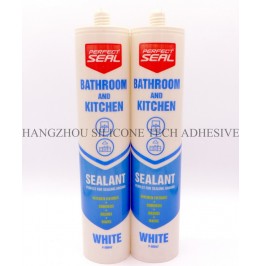
Silicone sealant bonds well to metal, tile, painted drywall, and most bathroom surfaces. It stays flexible for years, which matters because bathroom hardware expands and contracts with temperature changes. A towel bar near a hot shower gets warm. One in a guest bathroom stays cool. That movement stresses any rigid sealant, but silicone flexes with it.
Neutral-cure silicone is the safer pick for hardware bases. Acetoxy silicone works fine on tile and glass, but the vinegar smell during curing can be unpleasant in a small bathroom, and it can corrode certain metal finishes over time. Neutral-cure silicone has no smell, bonds better to painted surfaces, and is gentler on metal hardware.
Pick a silicone with antimicrobial additives if the hardware sits in a high-moisture zone — near the shower, above the tub, or behind the toilet. The antimicrobial agents do not kill existing mold, but they stop new spores from colonizing the sealant surface, which keeps the base looking clean longer.
Silicone bonds well to most surfaces, but it is not the strongest adhesive on the market. If your hardware base sits on a surface that is hard to bond to — glossy tile, unglazed ceramic, or a surface that has been painted multiple times — polyurethane sealant will outperform silicone.
Polyurethane grabs onto surfaces more aggressively and resists physical stress better. If someone yanks on a towel bar or bumps a robe hook hard, polyurethane holds the base in place where silicone might slowly peel away.
Hybrid sealants give you both options in one tube. They bond like polyurethane and flex like silicone. For hardware bases that need to stay glued to the wall under constant moisture and occasional physical abuse, hybrids are worth the extra effort to find.
Stay away from acrylic latex caulk on hardware bases. It is not waterproof, it shrinks as it dries, and it will pull away from the metal base within weeks. It has no business being anywhere near a bathroom fixture.
This sounds obvious, but a surprising number of people try to seal around a fixture that is still mounted. You cannot get a proper bead along the bottom edge if the base plate is pressed against the wall. The sealant gets squeezed out unevenly, it does not bond to the full surface, and you end up with a messy, incomplete seal.
Unscrew the fixture. Remove the base plate. Lay it on a towel. Now you have full access to the wall surface behind it, and you can apply sealant properly to both the wall and the back of the base plate.
If the anchors are stuck in the wall, cut them off with a small hacksaw or bolt cutters. You will replace them after sealing anyway, so do not worry about damaging them.
Scrape off any old sealant, adhesive, or caulk from the back of the base plate and the wall surface. Use a plastic putty knife — a metal blade can scratch polished metal finishes. Get into every corner, every edge, every spot where old material has accumulated.
Wipe both surfaces with isopropyl alcohol. Not soapy water. Isopropyl alcohol cuts through grease, removes soap scum, and evaporates completely, leaving a perfectly clean surface for bonding. Let everything dry for at least 20 minutes.
If the wall behind the base plate shows signs of water damage — soft drywall, discoloration, or crumbling — repair it before you rehang the fixture. Sealing over a damaged wall just traps moisture behind the plate and makes the problem worse. Cut out the bad section, patch the drywall, let it dry completely, and then seal.
Most tile and glazed surfaces do not need primer. But if the wall behind the hardware is painted drywall, raw plaster, or unglazed ceramic, a primer coat makes a real difference. Primer creates a chemical bridge between the sealant and the surface, especially on materials that silicone does not grip well.
Metal base plates — brushed nickel, matte black, chrome — also benefit from a metal primer. It prevents oxidation from interfering with the sealant bond and gives the sealant something solid to hold onto. Apply the primer to both the wall and the back of the base plate, let it dry, then move on to sealant.
Most people only seal the bottom edge of the base plate. That is the most important spot, but it is not the only one. Water can get in from the sides and the top as well. Any gap between the plate and the wall is a potential entry point.
Run a thin bead of sealant along the entire perimeter of the back of the base plate — top, bottom, left, right, all the way around. A continuous bead gives you full protection. Spot-sealing one edge leaves the rest exposed, and moisture will find those gaps over time.
The bead should be about 3 to 5 millimeters wide and deep. Thinner than that and it does not fill the gap. Thicker than that and it takes too long to cure and creates internal stress that leads to cracking.
If the gap between the base plate and the wall is very narrow — under 4 millimeters — you can apply sealant directly. But if the gap is wider, stuff a thin foam backer rod into the joint first.
The backer rod controls the depth of the sealant bead and gives it something to bond to. Without it, you end up using too much sealant, it cures unevenly, and the center of the bead stays soft for days. A backer rod also creates a slightly concave shape that directs moisture away from the joint.
Cut the rod to length, press it firmly into the gap so it sits flush with the wall surface, and then apply your sealant on top.
After applying the sealant to the back of the base plate, press it firmly into both the plate and the wall. Use your finger or a small tool to make sure the sealant makes full contact with both surfaces. Air pockets are the enemy — they create weak spots where moisture gets in and the bond fails.
Wipe your finger or tool with a damp cloth between passes. Work quickly — most sealants begin skinning over within 10 to 15 minutes, and once that happens, you cannot press the bead into the joint properly anymore.
When you rehang the hardware, tighten the screws until the base plate is snug against the wall — not until you are leaning your entire body weight on the screwdriver. Overtightening crushes the sealant bead, squeezes it out of the joint, and creates gaps where water gets in.
Snug is enough. The sealant does the waterproofing. The screws just hold the plate in place while the sealant cures.
Most sealants need 24 to 48 hours to cure fully. During that time, do not hang towels on the bar, do not put toilet paper on the holder, do not bump the robe hook. Let the sealant bond to both surfaces without any stress.
If you hang weight on the fixture before the sealant cures, you pull the bead away from the wall and create a gap. The sealant will bond to the fixture but not to the wall, and the whole thing fails from the wall side.
Towel bars mounted near the shower get hammered by steam and splashing water every single day. The sealant around these bases degrades faster than anywhere else in the bathroom.
Use a high-movement silicone or a hybrid sealant with antimicrobial additives. Apply it in thin layers over a backer rod, and check the seal every three to four months. If you see any cracking or separation, re-seal immediately. Do not wait until the fixture starts to wobble.
These fixtures get bumped constantly. Someone grabs the toilet paper, yanks it, and the whole holder shifts. That repeated stress pulls at the sealant bead over time.
Use polyurethane sealant for these bases. It bonds more aggressively than silicone and resists physical stress better. Apply a continuous bead around the entire perimeter, use a backer rod if the gap is wide, and let it cure fully before using the fixture.
Robe hooks carry weight — wet towels, bathrobes, loofahs. The base plate takes a lot of stress, especially if someone swings on the hook to pull a towel off.
Seal the base with a hybrid sealant or polyurethane. Apply a thick enough bead to fill the gap completely, press it into both surfaces, and make sure the bead fully encircles the base plate. Check these monthly — they get abused more than any other fixture in the bathroom.
Sealant does not last forever. In a bathroom environment, most base sealants start losing flexibility within two to four years. After that, you will notice small cracks forming along the bead, or the sealant will begin to pull away from the wall or the base plate.
Check every hardware base at least twice a year. Run your finger along the sealant bead and feel for any rough spots, gaps, or brittle areas. If the sealant feels hard instead of soft, it has lost its elasticity and needs to be replaced.
When re-sealing, always remove the old sealant completely. Scrape it off both the wall and the back of the base plate, clean the surfaces with isopropyl alcohol, reprime if needed, and apply fresh sealant in thin layers. Patching over old sealant with new sealant does not work — the old layer prevents proper adhesion, and the new sealant fails just as fast as the last one did.
One more thing worth mentioning: if your bathroom has poor ventilation, no amount of sealant will protect those hardware bases long term. An exhaust fan removes moisture before it has a chance to settle on the fixtures and attack the sealant. Sealant handles the water that gets in. A fan keeps the moisture from building up in the first place. Both together, and your bathroom hardware stays solid for years.
Copyright 2019 by Hangzhou Silicone Tech Adhesive Co., Ltd. All rights reserved.
Bathroom Sealant | Acrylic Sealant | Dow Corning 795 | Aquarium Sealant | Dow Corning 732 | Clear Silicone Sealant | Polysulfide Sealant | Glazing Sealant | Mirror Sealant | IG Sealant
Powered by Onepound


