E-mail:
sales@silicone-sealant-china.com

Walk into any bathroom and you will see them — pipes poking out of the wall, running along the floor, disappearing behind the vanity. Those pipe penetration points are silent trouble spots. Water leaks slowly around them, moisture creeps in from every direction, and before you know it, you have rotting subfloor, swollen cabinetry, and a wall that smells like something died behind it.
The fix sounds simple: slap some sealant around the pipe and call it a day. But if that is what you did, chances are the sealant cracked, peeled, or never bonded in the first place. Pipe perimeters are not like flat wall joints. They are round, they move, they vibrate, and they sit in the wettest parts of your bathroom. Sealing them properly requires a different approach.
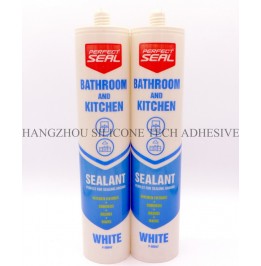
Most people treat a pipe-to-wall joint the same way they treat a tile-to-wall joint. They run a bead of sealant around the pipe and smooth it out. Looks fine for a month or two. Then the sealant starts cracking in a ring pattern right where it meets the pipe.
Here is what is actually happening. Pipes are not static. Hot water running through them causes thermal expansion — the pipe gets slightly wider when hot and contracts when cold. That tiny movement happens hundreds of times a day. A rigid sealant cannot handle that kind of repeated flexing. It cracks, gaps form, and water seeps through.
Then there is the shape problem. A pipe is round. Most sealants are applied on flat surfaces. When you try to press a flat bead of sealant against a round pipe, you get uneven contact. The sealant touches the pipe at the top and bottom but leaves gaps on the sides. Those gaps are where water gets in.
Vibration is another factor. Water hammer — that banging noise when you shut off a faucet fast — sends shockwaves through the pipes. Over time, that vibration loosens any sealant that was not applied with flexibility in mind.
Not all silicone is equal. Standard bathroom silicone is fine for static joints like tub-to-wall connections, but around pipes, you need a high-movement silicone. These formulations are designed to stretch and compress repeatedly without cracking. They stay elastic for years, even in constant moisture.
Look for sealants with a high elongation rating — ideally over 300 percent. That number tells you how much the sealant can stretch before it breaks. The higher the number, the better it handles pipe movement.
Acetoxy silicone cures fast and smells like vinegar. It works well around metal pipes. Neutral-cure silicone has no smell and bonds better to plastic and PVC pipes. Match your silicone type to your pipe material.
If the pipe goes through a floor or a wall where movement is significant — think washing machine drain lines or shower riser pipes — polyurethane sealant is worth considering. It bonds more aggressively than silicone to pipe materials and handles vibration better.
Hybrid sealants are another solid option. They give you the flexibility of silicone with the adhesion strength of polyurethane. For pipe perimeters where the sealant needs to stick to both the pipe and the surrounding tile or drywall, hybrids tend to outlast pure silicone.
Avoid acrylic latex caulk around pipes entirely. It is not waterproof, it shrinks as it dries, and it will pull away from the pipe within weeks. It has no business being anywhere near a water pipe.
This sounds obvious, but most people do not do it right. Wipe the pipe and the surrounding wall or floor with isopropyl alcohol. Not soapy water — isopropyl alcohol. It cuts through grease, removes soap scum buildup, and evaporates completely, leaving a dry surface for the sealant to grip.
If there is old sealant around the pipe, scrape it all off. Use a utility knife or a silicone scraper to get it down to bare surfaces. Any leftover old sealant creates a weak layer, and the new sealant will sit on top of it instead of bonding to the actual pipe and wall.
Dry the area thoroughly. Use a towel, then let it air dry for at least 30 minutes. Moisture trapped in the joint will cause the new sealant to fail from the inside out.
PVC and plastic pipes are notoriously hard for sealant to stick to. Their surface is smooth and non-porous, which means most sealants just slide off over time. A primer specifically designed for plastic surfaces creates a chemical bond that makes the sealant grip like crazy.
Metal pipes — copper, galvanized steel — also benefit from a metal primer. It prevents oxidation from interfering with the sealant bond and gives the sealant something solid to hold onto.
If your sealant manufacturer recommends a primer for your pipe material, use it. It adds two minutes to the job and can double the lifespan of your seal.
Never fill a pipe-to-wall gap entirely with sealant. It is a waste of material, it takes forever to cure, and it will crack because there is too much mass flexing against the pipe.
Stuff a foam backer rod into the gap first. The rod should be slightly larger than the gap so it stays in place when you press it in. Cut it flush with the wall surface, then apply your sealant over the top.
The backer rod gives the sealant a defined depth — usually 6 to 10 millimeters deep is ideal. This allows the sealant to flex without being stretched too thin. It also creates a concave profile that sheds water away from the pipe instead of trapping it.
A common mistake is trying to fill the entire gap in one go. Don't. Apply the sealant in thin layers, letting each layer cure before adding the next. Most sealants cure from the outside in. A thick bead will skin over on the surface while the inside stays soft for days. That creates internal stress, and the sealant cracks as it cures unevenly.
Apply a thin bead, smooth it, let it cure for 24 hours, then apply a second layer if needed. Two thin layers bonded together are far stronger than one thick glob.
After applying the sealant, tool it into a smooth ring around the pipe. Use a wet finger or a small silicone tool and press the sealant firmly against the pipe surface. The goal is full contact all the way around — no gaps, no air pockets, no thin spots.
Work the sealant into a slight concave shape, like a shallow bowl. This directs any water that hits the joint away from the pipe and toward the wall or floor, rather than letting it pool right at the penetration point.
Wipe your tool frequently with a damp cloth. A dry tool will grab the sealant and leave rough marks instead of a smooth finish.
Floor pipe penetrations are the most vulnerable spots in any bathroom. Water pools on the floor during showers, and that water sits right against the pipe base. The sealant here needs to be extra flexible because the floor itself can shift slightly with temperature and moisture.
Use a high-movement silicone or a polyurethane sealant at floor-level pipe joints. Apply a backer rod, build up thin layers, and tool it into a smooth ring that slopes slightly away from the pipe. Check these joints every few months — floor-level sealant degrades faster than wall-level sealant because it is exposed to standing water and foot traffic.
Wall penetrations are trickier because you often cannot see the other side of the pipe. If water is leaking behind the wall, you might not notice until the drywall is damaged.
For wall pipe joints, use a hybrid sealant with strong adhesion to both the pipe and the drywall or tile. Prime both sides if possible. Apply the sealant in layers and make sure the bead fully encircles the pipe — not just the visible half. Water does not care which side of the wall it comes from. It will find any gap.
Shower riser pipes — the ones that stick out of the wall and connect to your showerhead — are constant moisture zones. The sealant around these pipes gets hammered by hot water, steam, and cleaning chemicals daily.
Use a high-temperature silicone rated for continuous hot water exposure. Apply it in thin layers over a backer rod, and tool it smooth. Check these joints every three to four months and reapply if you see any cracking or separation. These pipes move the most in your entire bathroom, so the sealant needs to flex constantly without failing.
Even the best sealant job has a lifespan. In a bathroom environment, most pipe perimeter sealants last between three and five years before they start losing elasticity. After that, micro-cracks form, water begins to seep in, and you are back to square one.
Check your pipe seals at least twice a year. Run your finger along the sealant ring and feel for any rough spots, cracks, or gaps. If the sealant feels hard and brittle instead of soft and flexible, it is time to replace it. If you see any water staining on the wall or floor around the pipe, do not wait — re-seal immediately.
When re-sealing, always remove the old material completely. Do not apply new sealant over old sealant. The old layer will prevent proper adhesion, and the new sealant will fail just as fast as the last one did.
Copyright 2019 by Hangzhou Silicone Tech Adhesive Co., Ltd. All rights reserved.
Bathroom Sealant | Acrylic Sealant | Dow Corning 795 | Aquarium Sealant | Dow Corning 732 | Clear Silicone Sealant | Polysulfide Sealant | Glazing Sealant | Mirror Sealant | IG Sealant
Powered by Onepound


