E-mail:
sales@silicone-sealant-china.com

Let's be brutally honest—most bathroom sealant failures aren't the product's fault. They're the surface's fault. Skip proper base preparation, and even the most premium sealant will peel, crack, or mold within months. The truth is, that smooth, clean-looking countertop edge or bathtub junction? It's hiding dust, grease residue, and moisture that will sabotage your work before you even squeeze the first bead of sealant.
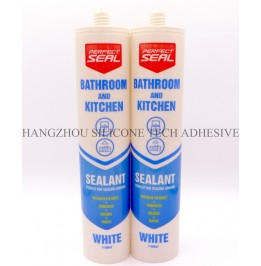
Getting the base surface right isn't glamorous, but it's the single most decisive factor in whether your bathroom stays dry for five years or starts weeping within six months.
Think of sealant adhesion like a handshake. If one party is sweaty, dirty, or wearing gloves, that grip fails. Bathroom environments amplify this problem dramatically—constant humidity, soap scum buildup, and mineral deposits from hard water create a hostile bonding surface.
Sealant manufacturers consistently emphasize that the substrate must be dense, solid, dry, and clean before application. Any contaminant acts as a release agent, creating what professionals call "false adhesion"—the sealant looks bonded but is actually sitting on a thin film of grime, ready to delaminate at the slightest stress.
The bonding strength required in bathrooms is significantly higher than in dry areas because the joint faces constant thermal cycling, water exposure, and mechanical movement from fixtures. Research from construction engineering handbooks confirms that improper surface preparation is the leading cause of sealant failure in wet rooms, accounting for the vast majority of callback complaints.
Before anything else, strip away every trace of old caulk. Use a utility knife or scraper held at a shallow angle—parallel to the surface—to avoid gouging the substrate. For stubborn remnants, a heat gun on low setting softens silicone enough to peel it cleanly. This step matters enormously: applying fresh sealant over old caulk creates a layered weakness where moisture gets trapped between incompatible bond lines.
One critical detail many DIYers miss—after mechanical removal, wipe the area with isopropyl alcohol or a dedicated solvent. This dissolves invisible oily residues that water-based cleaning simply cannot touch. If you skip this, you're building on a foundation of invisible contamination.
Bathroom surfaces accumulate two types of contaminants: particulate dust and oily films. Non-oily dust and grime respond well to washing with detergent solution and a lint-free cloth. But kitchen-adjacent bathroom areas, vanity tops near skincare products, and shower surrounds near body oils? Those require solvent cleaning—acetone or a commercial degreaser applied with a cloth, then allowed to evaporate completely.
The surface must be bone-dry before you proceed. Any visible moisture, condensation, or dampness will inhibit cure and promote adhesion failure. In practice, this means wiping the area, then waiting—sometimes 15 to 30 minutes depending on ventilation and ambient humidity.
Here's where things get technical. The ideal base surface temperature sits between 15°C and 27°C (roughly 59°F to 81°F). Going below 5°C slows cure dramatically and weakens final bond strength. Exceeding 50°C can cause the sealant to skin over too fast, trapping solvents underneath.
Also verify material compatibility. Silicone sealants bond excellently to glass, glazed tile, and most metals—but they struggle with certain plastics, natural stone like marble (which can leach oils), and painted surfaces that haven't been properly primed. If you're sealing a joint between dissimilar materials, a primer specifically designed for that substrate may be necessary. The general rule: if the surface feels powdery, chalky, or flaky, it won't hold sealant. Treat it first.
Most sealant technical data sheets specify an application range of 5°C to 35°C with relative humidity between 40% and 80%. Outside these windows, the chemistry changes. High humidity introduces moisture into the curing sealant, creating bubbles and reducing cross-link density. Low humidity can cause the surface to dry out the sealant too quickly from the edges inward, leading to poor interior cure.
If your bathroom just had a hot shower, wait at least an hour for steam to dissipate and surfaces to return to ambient temperature. Rushing this step is the fastest path to a job that looks perfect on day one and fails by month three.
Proper airflow accelerates solvent evaporation and promotes even curing. Open a window or run an exhaust fan—but avoid direct drafts that blow dust onto wet sealant. The first 24 hours are critical: the sealant transitions from a pliable state to a fully cross-linked elastomer. Disturbing it during this window—touching, water exposure, or vibration from nearby plumbing—compromises the molecular bond forming at the interface.
The industry standard curing time before exposing the joint to water is 24 hours minimum, with 72 hours recommended for shower floors and bathtub perimeters. Some engineering guidelines suggest waiting even longer for maximum bond development, particularly in high-moisture zones.
Applying sealant over a surface that looks clean but isn't—this is the silent killer. A fingerprint leaves skin oils. A damp cloth leaves mineral deposits. Even fresh paint can release plasticizers that interfere with adhesion.
Another frequent error: not taping off adjacent surfaces before application. Masking tape protects tiles, fixtures, and countertops from smears that become nearly impossible to remove once cured. Peel the tape while the sealant is still tacky—roughly 10 to 15 minutes after application—not after it fully skins over.
And never, ever apply sealant to a surface that's been previously sealed with a different chemistry without proper solvent cleaning. Silicone over acrylic, or polyurethane over silicone, creates an incompatible boundary layer that peels under the slightest stress.
The bottom line is unforgiving: surface preparation consumes roughly 60% of the effort in a proper sealant job, but it determines 100% of the outcome. Cut corners here, and you're not saving time—you're buying a future leak.
Copyright 2019 by Hangzhou Silicone Tech Adhesive Co., Ltd. All rights reserved.
Bathroom Sealant | Acrylic Sealant | Dow Corning 795 | Aquarium Sealant | Dow Corning 732 | Clear Silicone Sealant | Polysulfide Sealant | Glazing Sealant | Mirror Sealant | IG Sealant
Powered by Onepound


