E-mail:
sales@silicone-sealant-china.com

Most sealant manuals say "apply on a dry surface." Great. So how do you handle a bathroom that never actually dries? Showers run, pipes sweat, grout wicks moisture from below — your typical bathroom is a humidity war zone. Yet we still need to seal joints, baseboards, and fixtures in these conditions all the time.
The trick isn't avoiding moisture. It's working with it.
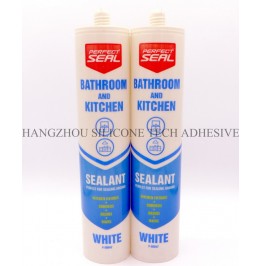
Here's what happens when people follow the "dry surface only" rule in a real bathroom. They wait until the shower hasn't been used for a day. Maybe two. They apply sealant, feel good about it — and within a week, it's peeling, bubbling, or turning black with mold.
Why? Because the surfaces were never truly dry. Grout lines hold moisture for days. Tile backer board absorbs water like a sponge. Even after the visible water is gone, there's residual humidity trapped in the substrate pores. That invisible moisture is enough to prevent proper adhesion, no matter how clean the surface looks.
So instead of chasing impossible dryness, focus on surface preparation that accounts for the moisture that's already there.
Not all sealants handle moisture the same way. This is where most people go wrong before they even pick up a tube.
Silicone-based sealants cure by reacting with atmospheric moisture. Sounds counterintuitive for a wet environment, but it actually works in your favor — they need humidity to cross-link properly. Acrylic-latex caulk, on the other hand, dries by losing water. In a humid bathroom, that water has nowhere to go, so the cure stalls indefinitely and the caulk stays soft and gooey.
For shower surrounds, tub perimeters, and any area exposed to direct water, silicone or hybrid polymer sealants are the only real option. They don't fight the moisture — they use it.
One thing to watch: some solvent-based sealants actually repel water during application, which sounds ideal. But those solvents off-gas and create a weak boundary layer between the caulk and the tile. In a steamy bathroom, that layer becomes a slip plane and the whole bead lifts off within weeks.
This is the part nobody talks about because it's messy and annoying. But it's the difference between a seal that lasts five years and one that fails in five months.
Start by running the hot shower for 15 minutes. Yes, really. You want every surface at maximum humidity so you can see exactly where water pools and where it beads up. Those pooling spots are where moisture will sit under your caulk later, so they need extra attention.
Wipe every joint with a lint-free cloth soaked in isopropyl alcohol. Not water — alcohol displaces moisture and evaporates fast. It won't dry the substrate completely, but it removes surface oils, soap scum, and biological film that block adhesion. Work in small sections — maybe 30 centimeters at a time — because the alcohol evaporates quickly in warm air.
For grout lines that are visibly damp, use a small brush to push in a moisture-tolerant primer before applying caulk. The primer bonds to the wet grout and gives the sealant something to grab onto. Without it, the caulk sits on top of the grout like a raft on a lake — it moves with every temperature shift.
If you're sealing around a drain or pipe penetration where water actively seeps, don't apply sealant directly. Pack the gap with a waterproof plugging compound or hydraulic cement first. Let it set for at least 20 minutes even if it's damp — these materials are designed to cure underwater. Then apply your sealant over the top. This two-layer approach handles active moisture that no surface prep alone can fix.
Forget everything you think you know about smooth, pretty bead lines. In a wet bathroom, aesthetics take a backseat to function.
Load your caulk gun and cut the nozzle at a sharp 45-degree angle. Use an opening slightly larger than the joint width — maybe 1 to 2 millimeters bigger. In humid conditions, the caulk skin forms faster on the surface, so a wider bead gives the interior more room to cure without being compressed.
Apply at a steady pace — not too fast, not too slow. Fast application traps air bubbles that expand in humidity and push the caulk off the joint. Slow application lets the surface skin set before the joint is filled, creating a hollow center.
Press the bead firmly into the joint with a tool or a gloved finger. Don't try to smooth it into a pretty curve. You want maximum contact between caulk and substrate. Every air gap is a future failure point, and humid air finds every gap eventually.
For corners and irregular joints, work in short segments — 10 to 15 centimeters max. Long continuous beads in humid air cure unevenly. The ends skin over first, trapping uncured material in the middle that never hardens properly.
Here's the part that frustrates everyone: you can't turn off the bathroom. Someone needs to shower. The pipes need to run. The humidity won't drop below 70% no matter how long you wait.
So stop waiting.
After application, close the bathroom door and turn on the exhaust fan if you have one. Run it continuously for 24 hours. This doesn't dry the room — it moves air across the caulk surface, which helps silicone-based sealants cure evenly and prevents condensation from forming directly on the bead.
Avoid running the shower for at least 48 hours. I know, that's hard in a shared bathroom. But direct water contact on uncured caulk creates a mechanical bond failure that no amount of later curing can fix. The water literally pushes the caulk out of the joint before it sets.
If you absolutely cannot avoid water exposure, apply a temporary barrier — a strip of plastic tape over the fresh caulk — until you can get 24 hours of dry time. It's ugly, but it works.
Temperature matters too. Cold bathrooms slow cure dramatically. If your bathroom sits below 10 degrees Celsius, most sealants will take twice as long to set. A small space heater aimed at the sealed area (not too close — keep it at least a meter away) can push the ambient temperature into the ideal 15 to 25 degree range and speed things up noticeably.
Sometimes you apply everything perfectly and the caulk still fails in a wet bathroom. That usually means the substrate itself is the problem.
Cracked tile, crumbling grout, or mold growing behind the caulk line — none of these get fixed by better application technique. If you pull back the old caulk and find black mold on the tile or grout, the sealant was doing its job. The problem is deeper. You need to kill the mold, dry the area properly, maybe replace damaged grout, and then re-seal.
If the caulk lifts in long strips rather than spotty patches, it's an adhesion issue. The surface wasn't compatible or wasn't prepped right. Try a different primer or switch to a polymer-modified sealant that bonds better to difficult substrates.
Patchy peeling in high-steam zones like shower corners usually means the joint was too wide for the caulk type. Some sealants max out at 6 millimeters of gap width. Wider joints need backer rod to reduce depth, then caulk on top. Without the rod, the caulk is too thick in the middle, cures unevenly, and pulls apart at the edges.
Bathrooms are one of the toughest environments for any sealant. Constant water, heat, cleaning chemicals, and biological activity all work against a perfect bond. But with the right chemistry, honest surface prep, and realistic expectations about curing time, you can get sealant to hold in even the wettest, most miserable bathroom on the block. It just takes a little more patience and a lot less finger-smoothing than most people are used to.
Copyright 2019 by Hangzhou Silicone Tech Adhesive Co., Ltd. All rights reserved.
Bathroom Sealant | Acrylic Sealant | Dow Corning 795 | Aquarium Sealant | Dow Corning 732 | Clear Silicone Sealant | Polysulfide Sealant | Glazing Sealant | Mirror Sealant | IG Sealant
Powered by Onepound


