E-mail:
sales@silicone-sealant-china.com

Nobody wants to stand in a steamy bathroom re-doing caulk every six months because black mold is already eating through the joint. The problem usually isn't the caulk itself — it's how it was applied. Most people use a gun, squeeze a bead, smooth it with a wet finger, and walk away. That method traps air, creates uneven thickness, and leaves weak spots where mold roots in fast.
There's a better way. And it only takes one pass.
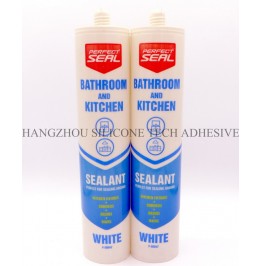
Let me be blunt: smoothing caulk with a wet finger is the single biggest reason bathroom sealant looks terrible within weeks. Water mixed into the bead surface creates a skin that doesn't bond properly. The interior cures slower than the exterior, leading to shrinkage cracks. And the uneven surface texture? It holds moisture like a sponge — perfect breeding ground for mold.
Add to that the fact most people apply too thin a bead in corners and too thick in the middle. The thick spots never fully cure, stay soft, and attract dirt. The thin spots pull away from the substrate under thermal cycling. Result: gaps everywhere, mold everywhere, frustration everywhere.
The one-pass method eliminates all of this by controlling bead geometry from the moment it leaves the nozzle.
Forget the plastic nozzle that came with the tube. Cut the tip at a 45-degree angle with a sharp blade, and use an opening between 4mm and 6mm depending on the joint width. Too small and you'll be pressing so hard the tube deforms. Too large and the bead collapses under its own weight.
Hold the gun at a steady 30-degree angle to the surface. Not flat, not vertical — tilted just enough that the caulk flows into the joint by gravity rather than force. Move at a consistent pace, roughly 15 to 20 centimeters per second. Jerky movements create ridges. Too slow and you over-fill.
The secret nobody talks about: keep the nozzle tip buried inside the bead as you move. Don't pull it out and drag across the top like frosting a cake. Buried application forces the material into every corner and micro-crevice of the joint in a single stroke.
You cannot skip prep and expect one pass to work. Period.
Use a joint tool or an old credit card to scrape out any loose old caulk. Get down to bare substrate. Then wipe the joint with isopropyl alcohol — not water, not soapy water. Alcohol evaporates fast and removes oils that silicone and acrylic sealants absolutely hate.
Let it dry for at least 15 minutes. I know that feels like forever when you're eager to start. But damp surfaces cause adhesion failure from day one, and no amount of perfect technique will save you.
For porous surfaces like unglazed tile or natural stone, apply a primer compatible with your caulk type. This step is non-negotiable on stone — without it, the caulk sits on top rather than bonding into the surface. One thin coat, let it flash off for 10 minutes, then apply your caulk.
Tape both edges of the joint with low-tack masking tape. This gives you a clean line, prevents caulk from smearing onto adjacent tile, and — crucially — creates a slight concave profile when you remove the tape. That concave shape sheds water instead of pooling it. Pooling water is mold's best friend.
Applying mold-resistant caulk in a bathroom right after a hot shower is a recipe for disaster. Surfaces are wet, humidity is near 100%, and temperatures fluctuate wildly.
Wait until the bathroom has been unused for at least two hours. Run an exhaust fan if needed. The ideal surface temperature is between 10°C and 35°C. Below 10°C, most sealants cure too slowly and stay vulnerable to mold for days. Above 35°C, skinning happens too fast and the interior never fully sets.
If your bathroom has no windows and poor ventilation, consider using a portable dehumidifier for 24 hours before and after application. I know that sounds excessive. But mold doesn't care about your timeline — it starts colonizing within 24 to 48 hours on any surface that holds moisture.
No smoothing. No finger. No water.
A properly executed one-pass bead should be slightly concave, uniform in width from end to end, and fully seated into the joint with no air pockets visible. Run your fingernail along it — it should feel smooth but not glossy. A glossy surface means you compressed it too much and sealed in air.
Remove the masking tape within 15 to 20 minutes of application while the caulk is still slightly tacky. Pulling tape too early drags caulk out of the joint. Waiting too long means the bond to the tape is stronger than the bond to the tile, and you'll tear the edge.
For inside corners where two walls meet, don't try to force a single bead around the bend. Apply two separate beads meeting at the corner, each pressed firmly with a joint tool. The overlap creates a sealed vertex without stretching the material thin.
Here's where patience pays off. Leave the caulk completely alone for 24 hours. No water testing, no wiping, no adjusting. The surface skin that forms in the first few hours is fragile — disturbing it breaks the seal.
After 24 hours, you can expose it to water. But even then, avoid direct high-pressure spray on the bead for another 48 hours. Gentle moisture is fine. Forceful water jets can mechanically push uncured caulk out of shallow joints.
Full cure strength takes 7 days for most bathroom-grade formulations. During that week, the caulk is hardening from the outside in. Any stress — thermal expansion, fixture vibration, accidental bumping — can compromise the bond if the interior hasn't set yet.
Walk through your bathroom a week after application. Look for three things: gaps where the caulk pulled away from the tile, bubbles trapped under the surface, and areas where the bead is thinner than a millimeter.
Gaps mean the joint wasn't clean enough or the primer failed. Bubbles mean you moved too fast or the surface was too warm. Thin spots mean your nozzle was too small or you angled the gun wrong.
Fix any issues immediately by cutting out the bad section with a utility knife, re-cleaning, and re-applying. Don't try to patch over problems — the new caulk won't bond to old cured caulk reliably.
Bathrooms are brutal environments. Constant moisture, temperature swings, cleaning chemicals, and biological growth all work against your sealant. The one-pass method won't make the caulk invincible — but it gives you the densest, most uniform, most mold-resistant bead possible in a single application. And that small difference is what keeps your grout lines white and your bathroom fresh for years instead of months.
Copyright 2019 by Hangzhou Silicone Tech Adhesive Co., Ltd. All rights reserved.
Bathroom Sealant | Acrylic Sealant | Dow Corning 795 | Aquarium Sealant | Dow Corning 732 | Clear Silicone Sealant | Polysulfide Sealant | Glazing Sealant | Mirror Sealant | IG Sealant
Powered by Onepound


