E-mail:
sales@silicone-sealant-china.com

Most homeowners don't think about their ductwork until something goes wrong — a room that never quite reaches the right temperature, energy bills that creep up every winter, or a faint whistling from the ceiling that wasn't there before. In most cases, the culprit is the same: unsealed or poorly sealed duct joints letting conditioned air escape before it reaches its destination.
Studies suggest that typical residential duct systems lose between 20 and 30 percent of the air they move to leaks and poor connections. That's not a minor efficiency problem — it's the equivalent of leaving a window open all winter. Sealing duct vents is one of the most cost-effective home improvements you can make, and for most accessible ducts, it's a job a reasonably handy person can tackle in an afternoon.
Before you choose a sealant, it helps to know what you're dealing with. Duct systems typically have several types of joints:
Each type has slightly different sealing requirements, but the same core principle applies: you need to create an airtight seal that can flex slightly as the duct expands and contracts with temperature changes, and that won't crack or peel over years of use.
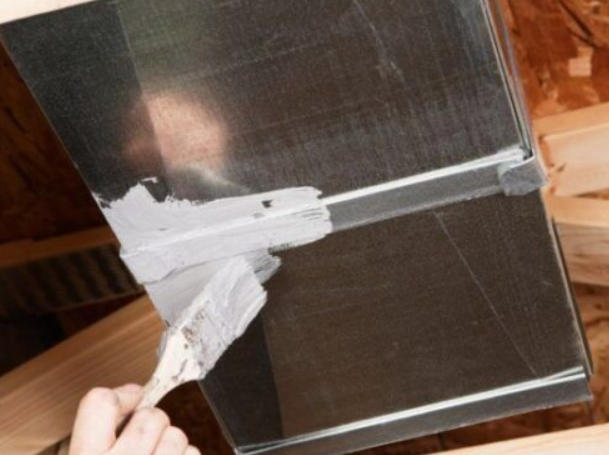
Mastic is the go-to choice for HVAC professionals sealing rigid sheet metal or fibreglass ductwork. It's a thick, paste-like compound — usually grey or white — that you brush or trowel onto the joint. Once it cures, it forms a flexible, airtight coating that bonds well to metal, fibreboard, and fibreglass duct materials.
The main advantages of mastic are durability and conformity. It fills small gaps and irregularities that tape can't bridge, it doesn't dry out and crack like some mastics on the market, and a well-applied mastic joint will outlast the ductwork around it. The downside is that it's messy to apply — you'll want gloves and old clothes — and it takes several hours to cure fully.
For large gaps (more than about 6 mm), use fibreglass mesh tape over the joint first and then apply mastic over the top. This reinforced approach is standard practice on older ductwork where joints have shifted or been moved around over the years.
Where mastic can be awkward — particularly on the connection between a register boot and drywall, or where a duct meets a dissimilar material like concrete or wood — silicone sealant is the practical choice. It adheres well to a wider range of substrates, remains permanently flexible, and handles the temperature swings inside a duct system without cracking.
For most duct-to-register sealing applications, a neutral-cure silicone is preferable to acetic-cure (the type that smells of vinegar), since neutral silicone is less corrosive to metal and performs better in confined spaces. Our neutral silicone sealant range is well-suited to HVAC applications — it maintains its flexibility across the temperature range you'd encounter in a typical duct system, bonds to both metal and drywall, and cures without the strong acid smell that can linger in ductwork.
Foil tape — not standard duct tape, which fails surprisingly quickly in thermal cycling conditions — can work well on accessible joints that don't move much. It's fast to apply, immediately effective, and holds up reasonably well if the surface is clean and dry when you apply it. However, it's not a substitute for mastic or silicone on joints that see significant temperature variation or that are hard to access for future maintenance.
One important note: avoid standard grey "duct tape" for this application. Despite the name, it's not rated for HVAC use and typically fails within a year or two when exposed to the temperature cycles inside a duct system. Always use proper aluminium foil HVAC tape.
The most obvious leaks are audible — you can hear air hissing from a joint when the system is running. For less obvious leaks, hold a piece of tissue or incense stick near suspected joints while the system runs; any deflection indicates air movement. A pressure test (done by HVAC professionals with a duct blaster) will give you precise leakage figures, but for most DIY purposes, a visual inspection and the tissue test are sufficient.
Pay particular attention to joints near the air handler (where leaks are most significant since the pressure is highest), any joints that have been disturbed during other work, and register boots at floor and ceiling level.
Whatever sealant you're using, surface preparation makes a significant difference. For metal ducts, wipe the area around the joint with a dry cloth to remove dust and loose debris. For particularly dirty or greasy joints, a light wipe with isopropyl alcohol will help — but make sure it's fully evaporated before you apply sealant.
If you're applying mastic, make sure there are no loose sheet metal screws or fasteners that will prevent the joint from sitting flat. Tighten or replace any that are loose.
For mastic: Use a brush or gloved hand to apply a generous coat over the joint, extending at least 25 mm either side. Work it into any gaps and check that there are no holidays (missed areas). For larger gaps, apply fibreglass mesh tape first and bed it into the mastic, then apply a second coat over the top.
For silicone: Cut the nozzle to give a bead diameter appropriate to the gap you're filling — typically 6–8 mm for most duct applications. Run a continuous bead around the joint and tool it immediately with a wet finger or sealant tool to press it into contact with both surfaces. Our acetic silicone sealant is another option for purely metal-to-metal connections where the acid-cure chemistry isn't a concern — it cures faster than neutral silicone in most conditions.
For foil tape: Cut the tape to length, peel the backing, and apply firmly, pressing it down from the centre outward to avoid air bubbles. Run your finger or a rag firmly along the tape to ensure full contact.
Mastic typically needs 4–8 hours to cure before the duct system is pressurised; in cold or damp conditions, allow overnight. Silicone sealant skins quickly (usually 30–60 minutes) but benefits from a full cure of several hours before the system is run at full temperature. Check the product datasheet for specific cure times.
Flexible duct connections are a separate challenge. The connection between the flex duct inner liner and a rigid fitting needs both mechanical fastening (a metal band clamp or similar) and sealing. Mastic works well here when brushed over the connection after the clamp is tightened. For the outer jacket, foil tape applied neatly over the vapour barrier will prevent condensation issues as well as air leakage.
Avoid simply pulling flexible duct over a collar and trusting the friction fit — it may hold in the short term but will almost certainly leak within a year or two as the duct moves under thermal cycling.
Sealing is appropriate when the underlying ductwork is structurally sound — no major dents, no crumbling fibreglass, no corrosion that's compromised the metal. If you're finding that a joint needs re-sealing every few years, it's worth considering whether the duct section itself needs replacing rather than patching again.
For older homes where the ductwork hasn't been touched in 20+ years, a comprehensive sealing job — covering all accessible joints and register boots — can make a noticeable difference to both comfort and energy bills. If you're not sure where to start, the register boots in each room are often the single biggest source of leakage and the most accessible to seal. Our neutral silicone sealant is a practical starting point for homeowners tackling this job for the first time — it's forgiving to apply, bonds to a range of substrates, and once cured it requires no maintenance.
Sealing duct vents is a straightforward job that pays dividends in energy savings and comfort. Use mastic sealant for the majority of rigid duct joints, silicone sealant where you're bridging dissimilar materials or working around register boots, and proper aluminium foil tape for accessible, low-movement joints. Prepare surfaces properly, apply generously, and allow the sealant to cure before running the system. Done correctly, a good seal should last the life of the ductwork.
Copyright 2019 by Hangzhou Silicone Tech Adhesive Co., Ltd. All rights reserved.
Bathroom Sealant | Acrylic Sealant | Dow Corning 795 | Aquarium Sealant | Dow Corning 732 | Clear Silicone Sealant | Polysulfide Sealant | Glazing Sealant | Mirror Sealant | IG Sealant
Powered by Onepound


