E-mail:
sales@silicone-sealant-china.com

When undertaking a bathroom sealant application project, accurately calculating the amount of materials needed is crucial. It helps in avoiding wastage, ensuring cost - effectiveness, and preventing shortages that could disrupt the workflow. Here's a comprehensive guide on how to calculate the material quantities for bathroom sealant application.
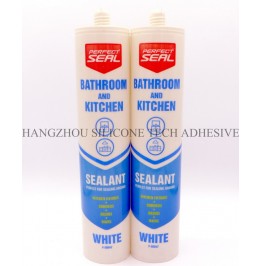
Before diving into calculations, a detailed understanding of the bathroom layout and the areas that require sealing is essential.
Start by identifying all the joints in the bathroom that need to be sealed. Common areas include the joints between the bathtub and the wall, the shower tray and the surrounding tiles, the gaps around the sink, and the corners where walls meet. Each of these joints has different lengths and widths, which will impact the amount of sealant required. For example, the joint around a standard - sized bathtub may be longer compared to the joint around a small bathroom sink.
Once the joints are identified, measure their lengths and widths accurately. Use a tape measure to get precise measurements. For linear joints, such as the ones along the edges of the bathtub or shower tray, measure the length in meters or feet. For joints with a non - uniform width, measure the width at multiple points and take an average. This is important because variations in joint width can lead to inaccurate calculations if not accounted for properly.
With the joint dimensions in hand, you can proceed to calculate the amount of sealant needed.
Different types of sealants have different coverage rates per unit volume. This information is usually provided by the manufacturer on the product packaging or in the technical data sheet. The coverage rate is typically given in terms of linear meters or feet that a certain volume of sealant can cover at a specific joint width. For instance, a particular sealant may state that it can cover 10 linear meters when applied to a joint with a width of 5 millimeters and a depth of 3 millimeters.
To calculate the total amount of sealant required, first, calculate the total length of all the joints that need to be sealed. Then, based on the average joint width and the coverage rate of the sealant, determine the volume needed. For example, if the total length of all joints is 20 meters, the average joint width is 6 millimeters, and the sealant coverage rate is 8 linear meters per 100 - milliliter tube for a 5 - millimeter - wide joint, you'll need to make some adjustments. Since the joint width is 6 millimeters, which is slightly wider than the reference width in the coverage rate, you can estimate that the coverage will be less. A rough estimate could be that the 100 - milliliter tube will cover around 6 - 7 linear meters. So, for 20 meters of joints, you may need approximately 3 - 4 tubes of sealant (20 / 6 - 7 ≈ 3 - 4).
In real - world scenarios, it's important to account for wastage and other factors that can affect the actual amount of sealant needed.
During the application process, there will inevitably be some wastage. This can occur due to over - application, spillage, or the need to re - do certain sections. A common rule of thumb is to add an additional 10 - 20% to the calculated amount of sealant to account for wastage. For example, if your initial calculation suggests you need 300 milliliters of sealant, adding 15% wastage would mean you should purchase around 345 milliliters (300 + (300 * 0.15)).
If the bathroom has complex joints, such as those with sharp corners or irregular shapes, more sealant may be required to ensure proper coverage. Additionally, in some cases, multiple layers of sealant may be necessary for better durability and waterproofing. For example, in areas that are constantly exposed to water, like around the showerhead, applying two thin layers of sealant may be more effective than one thick layer. Each additional layer will increase the amount of sealant needed, so factor this into your calculations.
In addition to the sealant itself, surface preparation materials are also an important part of the bathroom sealant application process, and their quantities need to be calculated as well.
Before applying the sealant, the surfaces need to be thoroughly cleaned to remove dirt, grease, and old sealant residues. The amount of cleaning agent required depends on the size of the bathroom and the level of dirtiness. Generally, a small bottle of a standard cleaning agent may be sufficient for a regular - sized bathroom. However, if the bathroom is particularly large or heavily soiled, you may need more. You can estimate the quantity based on the manufacturer's recommended dilution ratio and the area to be cleaned.
Some types of sealants may require the use of a primer on the surface before application. The primer helps improve the adhesion of the sealant to the surface. The quantity of primer needed is usually calculated based on the coverage rate provided by the manufacturer. Measure the area of the joints that will be primed and use the coverage rate to determine the amount of primer required. Similar to sealant, add a small percentage for wastage when purchasing the primer.
Copyright 2019 by Hangzhou Silicone Tech Adhesive Co., Ltd. All rights reserved.
Bathroom Sealant | Acrylic Sealant | Dow Corning 795 | Aquarium Sealant | Dow Corning 732 | Clear Silicone Sealant | Polysulfide Sealant | Glazing Sealant | Mirror Sealant | IG Sealant
Powered by Onepound


