E-mail:
sales@silicone-sealant-china.com

It is the question every first-time user asks while standing in the aisle, tube in hand: can this stuff actually hold up the shelf, or am I going to find it on the floor in three weeks? The marketing claims are bold. The real answer is more useful than any brochure.
Short version: a single metre of No More Nails adhesive bead will hold somewhere between 40 and 80 kilograms once fully cured, depending on the substrate and how it was applied. That is a wide range for a reason, and the gap between the low and high end is where most failed DIY jobs live.
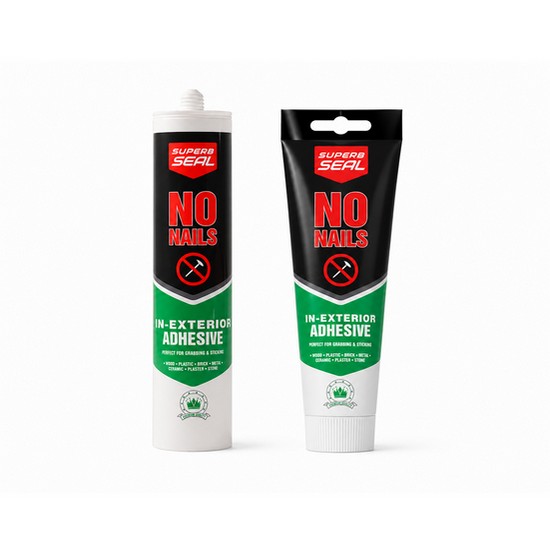
A standard 290ml cartridge of high-grab adhesive is enough to bond roughly 10–12 metres of bead under typical DIY conditions.
Before quoting numbers, it helps to separate two very different things the product is asked to do.
Instant grab is the weight the adhesive holds the moment the two surfaces are pressed together. This is the number on the front of the tube. For most modern high-grab formulations it is around 20 to 40 grams per square centimetre — enough to stop light items from sliding down a wall while the cure progresses.
Full-cure bond strength is the weight the joint holds after 24 to 72 hours, when the adhesive has finished cross-linking. This is the number that matters for anything that is going to carry a real load. It is also the number that almost nobody quotes on the packaging.
The honest answer to "how much weight" depends on which number you mean, what you are sticking it to, and how carefully you prepared the surface.
Manufacturer technical data sheets for high-grab solvent-based adhesives typically report:
Translated into something a homeowner can picture: a properly applied bead, cured for 48 hours on clean dry plasterboard, will hold a framed mirror, a floating shelf full of paperbacks, or a coat rack with a winter's worth of jackets. It will not, on its own, hold a wall-mounted TV, a kitchen cabinet full of crockery, or a bookshelf that a child is going to climb.
This is the single biggest variable. A high-grab adhesive on dusty, oily, or damp plasterboard might achieve a tenth of the strength of the same product on clean, sound substrate. A quick wipe with a lint-free cloth and a degreaser is not optional — it is the difference between a bond that lasts years and one that peels off in a week.
Porous surfaces (plaster, brick, concrete, raw wood) hold best because the adhesive can key into the surface texture. Smooth non-porous surfaces (glass, glazed tile, metal) hold less and benefit from a light scuff with sandpaper.
More adhesive equals more contact area, and more contact area equals more holding power — but only up to a point. A 10mm bead has roughly four times the grip of a 5mm bead, but a 20mm bead does not double that again because the inner core never cures. The sweet spot for most grab adhesives is a bead between 5mm and 10mm wide.
For long items, run several parallel beads rather than one fat one. For wide panels, add a zig-zag or full perimeter pattern so the load is distributed. The bead pattern is doing the work that screws would do in a mechanical fix.
Most grab adhesives reach roughly 50% of their final strength in the first 6 hours and 90% within 24 hours. Heavy items should be supported (with tape, props, or a temporary nail) for the first 8 to 15 hours regardless of what the tube claims about instant grab. Skipping that step is the most common cause of "the adhesive failed" complaints that were really "I never let it cure" failures.
Some real-world numbers that match what most homeowners actually try to mount:
If the item is heavy, the load is dynamic (it will be pulled, leaned on, or vibrated), or failure would be dangerous or expensive, reach for a mechanical fixing first and use No More Nails as the backup. A mastic sealant can be used to seal around the fix afterwards, but it is not doing the structural work.
Outdoor use also needs a product rated for the conditions. Standard interior adhesives do not like standing water, freeze-thaw cycles, or sustained UV. The exterior-grade version of the same grab adhesive is rated for those conditions and is worth the small extra cost.
A cartridge of No More Nails will hold somewhere between 40 and 80 kilograms per metre of bead when applied to a clean, sound substrate and given 24 hours to cure. The exact number depends far more on how well you prepared the surface than on which brand of adhesive you chose. For the dozens of light-to-medium fixing jobs that show up around any home, it is fast, clean, and strong enough. For the heavy stuff, treat it as a backup to a proper mechanical fixing and the bond will outlast the wall it is stuck to.
Copyright 2019 by Hangzhou Silicone Tech Adhesive Co., Ltd. All rights reserved.
Bathroom Sealant | Acrylic Sealant | Dow Corning 795 | Aquarium Sealant | Dow Corning 732 | Clear Silicone Sealant | Polysulfide Sealant | Glazing Sealant | Mirror Sealant | IG Sealant
Powered by Onepound


